


Tokat kebabı
Lamb and vegetable oven kebab
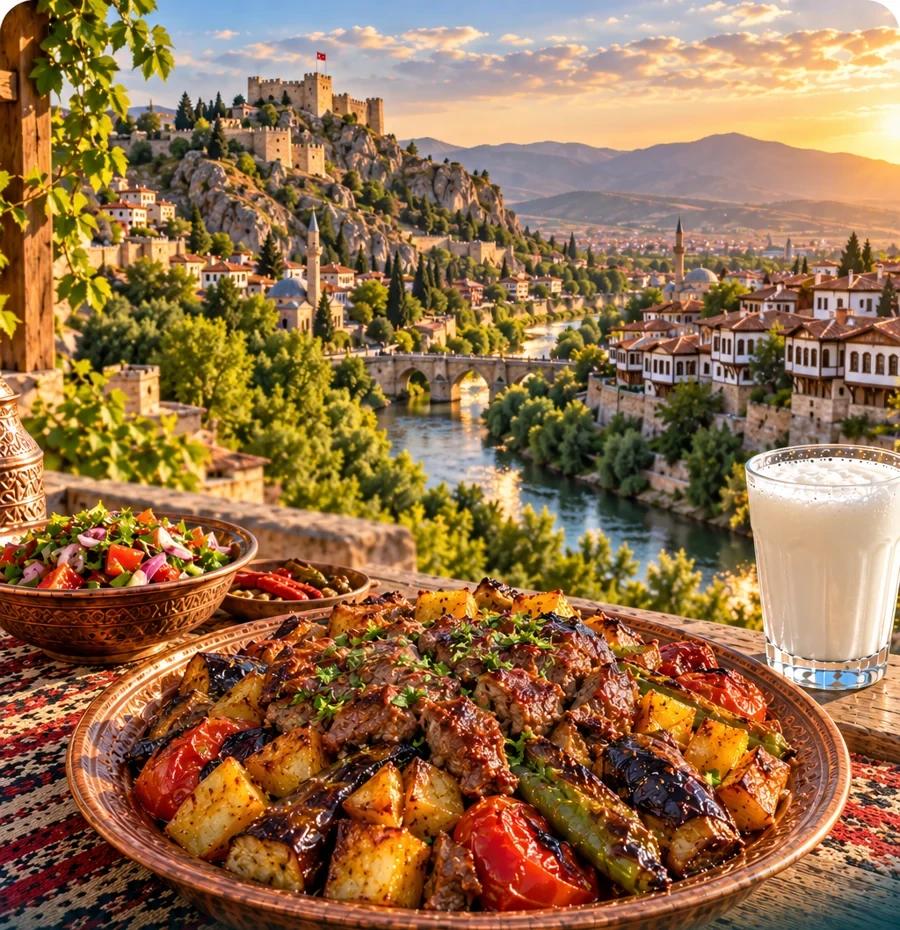
Karayaka lamb, tail fat, potato and eggplant on skewers, cooked in a wood-fired oven with tomatoes, Tokat peppers and garlic and served on thin pide.
Black Sea Region
A good way into Tokat's kitchen is to follow the Narince grape. Its must, boiled down and joined with fine wheat groats, is dried into Tokat üzüm tarhanası. In Zile kömesi, Tokat walnuts are coated in hasuda, a thickened Narince must cooked in copper cauldrons over a wood fire. The vine's young leaves, meanwhile, are brined and fermented. Step away from the grape and Tokat kebabı takes over the table: Karayaka lamb, tail fat, potato and eggplant, joined by tomatoes, garlic and small Tokat peppers skewered whole, arrive from a wood-fired oven on thin pide. Turhal yoğurtmacı is a sesame-topped stone-oven pastry, its yeast dough folded again and again around walnut or poppy seed and fat. For a simpler bowl, bacaklı çorba brings erişte noodles together with green lentils. From vineyard to oven, the same grape gives both a sweet and a brine, and the same oven fire serves both kebab and pastry. To explore Tokat, you need only choose which of those two trails to follow first.
Last updated:
Vineyards on the hills of the Yeşilırmak valley around Tokat.
Explore the oven, vineyard and walnut orchard without losing the names of individual districts.
Lamb and vegetable oven kebab
Karayaka lamb, tail fat, potato and eggplant on skewers, cooked in a wood-fired oven with tomatoes, Tokat peppers and garlic and served on thin pide.
Folded walnut pastry
Yeast dough spread with walnut or poppy seed and fat, folded again and again, topped with sesame and baked in a stone oven.
Grape must and wheat sweet
Narince grape must boiled down with fine wheat groats, set in trays, cut into pieces and dried, sometimes with walnuts.
Walnuts coated in grape must
A walnut sucuk: Tokat walnuts coated in hasuda, a thickened Narince grape must cooked in copper cauldrons over a wood fire.
Noodle and green lentil soup
Soup of erişte noodles and green lentils.
Recipes from this city are coming soon.
Young Narince vine leaves blanched in salted hot water, brined and fermented.
Guide not written yetWalnuts from Niksar, harvested in September and October.
Guide not written yetSmall local pepper skewered whole for Tokat kebabı.
Guide not written yetLamb of the local Karayaka sheep, used with its tail fat for Tokat kebabı.
Guide not written yetGrape molasses made in Zile.
Guide not written yetYazmacılık, the printing and decoration of textiles, is a documented Tokat craft. The provincial culture directorate also records copper work, weaving and instrument making, while acknowledging that crafts change under economic and technological pressures. Food production similarly has district identities: Niksar walnuts, Turhal yoğurtmaç and Zile grape preparations are useful names to retain. They describe specific associations rather than a uniform province-wide recipe.
Narince grapes give brined vine leaves, the must of üzüm tarhanası and the hasuda of Zile kömesi.
Tokat kebabı is skewered with lamb, tail fat, potato and eggplant and hung in a dedicated oven.
Tokat’s story begins with the castle that rises on steep rocks in the middle of the city. Established in the Roman period for road safety, it remained under Byzantine rule for a long time before Danişmend Melik Gazi first took it. Below, Sulu Street forms Tokat’s old city center and its historical trading district. Canal Tokat, a traditional waterway shaped within the city’s historic urban fabric, served the city’s water needs during the Seljuk and Ottoman periods.
The Yağıbasan Madrasa, also known as Çukur Medrese, is important as one of the first examples of Anatolian madrasas with closed courtyards. Gök Madrasa, from the thirteenth century, carries distinctive features of Anatolian Seljuk art, with tiles in aubergine purple, dark blue and turquoise alongside geometric and plant ornament. Further out, south of the Pazar district center, Ballıca Cave offers an entirely different landscape, known for its onion stalactite formations and the dwarf bats that live there in colonies.


