


Amasya keşkeği
Wheat and mutton keşkek
Keşkek wheat, mutton, bone marrow, tail fat, chickpeas and fenugreek cooked in a clay pot in a wood-fired oven, with the grains left whole.
Black Sea Region
Start your visit to Amasya’s table with a clay pot called a cab, in which keşkek wheat, mutton, bone marrow, tail fat, chickpeas and fenugreek cook together in a wood-fired stone oven. Nothing is pounded, so the grains of Amasya keşkeği stay whole. Toyga çorbası, served like keşkek at weddings and special invitations, is a thick soup made with strained yogurt, hulled wheat, chickpeas, flour and egg yolk, finished with butter and mint. In baklalı dolma, fava beans go into the stuffing, and the rolled dolma cook with lamb ribs laid on top. If you stop in Gümüşhacıköy, look for erikli, a dish particular to the district: lamb cooked with amasgen plums and served in tinned copper bowls. Then turn towards the province’s orchards: fragrant, thin-skinned misket apples, half red and half green, come from them, and so do large, round, heart-shaped Amasya cherries.
Last updated:
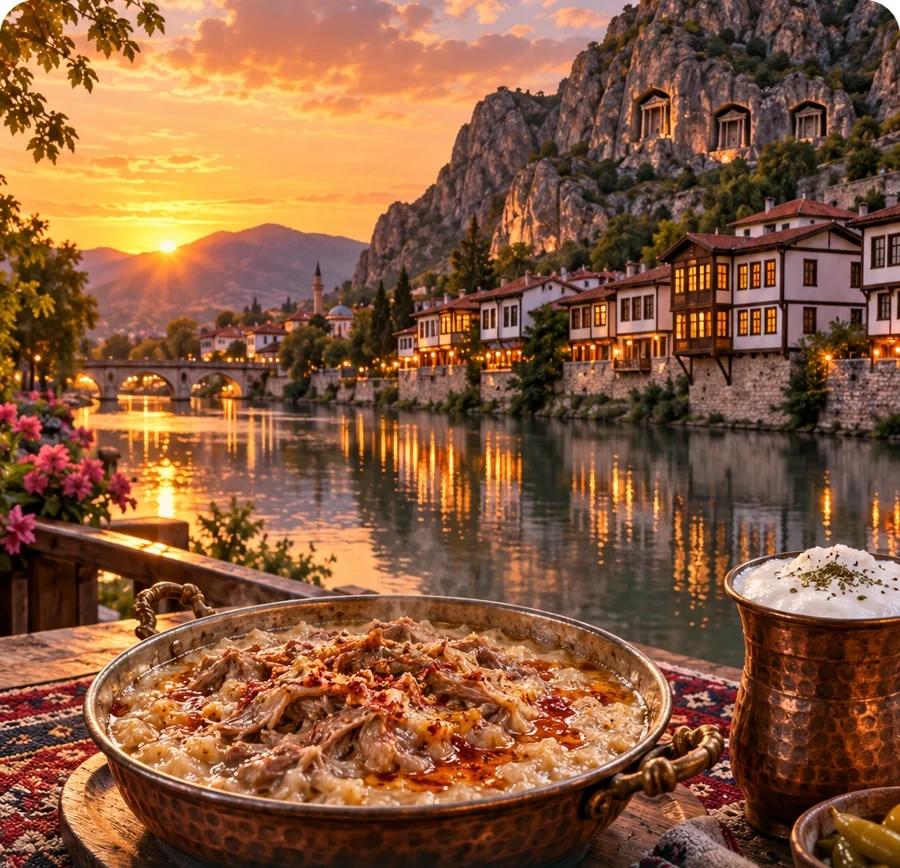
Riverside orchards, keşkek pots and walnut çörek.
Start with the apple, then discover filled leaves, savory baking and yogurt-based soup.
Wheat and mutton keşkek
Keşkek wheat, mutton, bone marrow, tail fat, chickpeas and fenugreek cooked in a clay pot in a wood-fired oven, with the grains left whole.
Yogurt and wheat soup
A thick soup of strained yogurt, hulled wheat, chickpeas, flour and egg yolk, finished with butter and mint.
Dolma with fava beans
Rolled dolma with fava beans in the stuffing, cooked with lamb ribs on top.
Eggplant with mutton ribs
Fried eggplant baked with tomatoes and mutton ribs.
Small dried okra with meat
A meat dish made with the small dried okra known locally as çiçek bamya.
Walnut and poppy seed bun
A baked bun of dough, walnuts and poppy seeds.
Walnut and poppy seed flatbread
Yeast dough layered with sunflower oil, walnuts and poppy seeds and cooked on a griddle, made for weddings, holidays and funerals.
Lamb with plums
Lamb cooked with amasgen plums, a Gümüşhacıköy dish served in tinned copper bowls.
Recipes from this city are coming soon.
Fragrant, thin-skinned apples, half red and half green.
Guide not written yetLarge, round, heart-shaped cherries.
Guide not written yetSmall okra, dried for local dishes.
Guide not written yetSilk weaving is another strand of Amasya’s cultural history. The Ministry’s craft inventory records declining practice and efforts to revive it through local training programmes. That account describes preservation work; it should not be read as a current timetable of courses. Food also carries skilled handwork. Rolling çörek dough or filling leaves makes preparation visible, while orchards and fruit names draw attention to the ingredients themselves. These are complementary ways to explore the city’s wider provincial culture.
Keşkek and toyga çorbası are served at weddings and special invitations.
Misket apples and large, heart-shaped cherries come from the province’s orchards.
Amasya’s geography introduces it first. The city was founded in a deep valley formed by the Yeşilırmak River, which flows between high mountains extending east to west, and it lies at the junction of the roads connecting the Black Sea coast with the rest of Anatolia. North of the river rises Mount Harşena, a limestone mass shaped like a pointed cone. Mithridates I Ktistes, who established the Pontic Kingdom, made Amaseia its capital.
That royal era can be traced in the rock-tombs of the Pontic Kings, carved into the limestone of Harşena’s southern hillside. The corridor meant to surround Tomb V, which belongs to Pharnakes I, was abandoned before completion, evidently when the king decided to move his capital to Sinope. In the Ottoman period the city was organised as a shahzade district, and some of the princes who served there later ascended the throne. Along both banks of the river, the surviving Yalıboyu Houses were mostly built in the 19th century.


