


Sivas köftesi
Salt-seasoned grilled köfte
Beef and mutton seasoned only with rock salt, shaped into small flat ovals, grilled over oak charcoal and served on pide.
Central Anatolia
Two things shape the Sivas kitchen: the fire of the hearth and the work of preparing for winter. On the fire side stands Sivas köftesi. Beef and mutton take a single seasoning, rock salt from the village of Tuzlagözü in Zara, and are grilled as small, flat ovals over oak charcoal before arriving on pide. For sebzeli Sivas kebabı, skewers of meat and vegetables are hung upright on wires over an open hearth to cook. Preparing for winter begins in spring, when fresh milk becomes peskütan, a yogurt-like preserve kept for the cold months. Later it turns, with cracked wheat and green lentils, into a thick soup. Beet stalks become pezik pickle, which then reaches the table with onions and eggs as turşu mıhlaması. Divriği pilavı brings rice together with lamb, onion, chickpeas, currants, allspice, pine nuts and butter. In a kitchen that runs from Tuzlagözü salt to spring milk and beet stalks, each plate points you toward another ingredient worth following in Sivas.
Last updated:
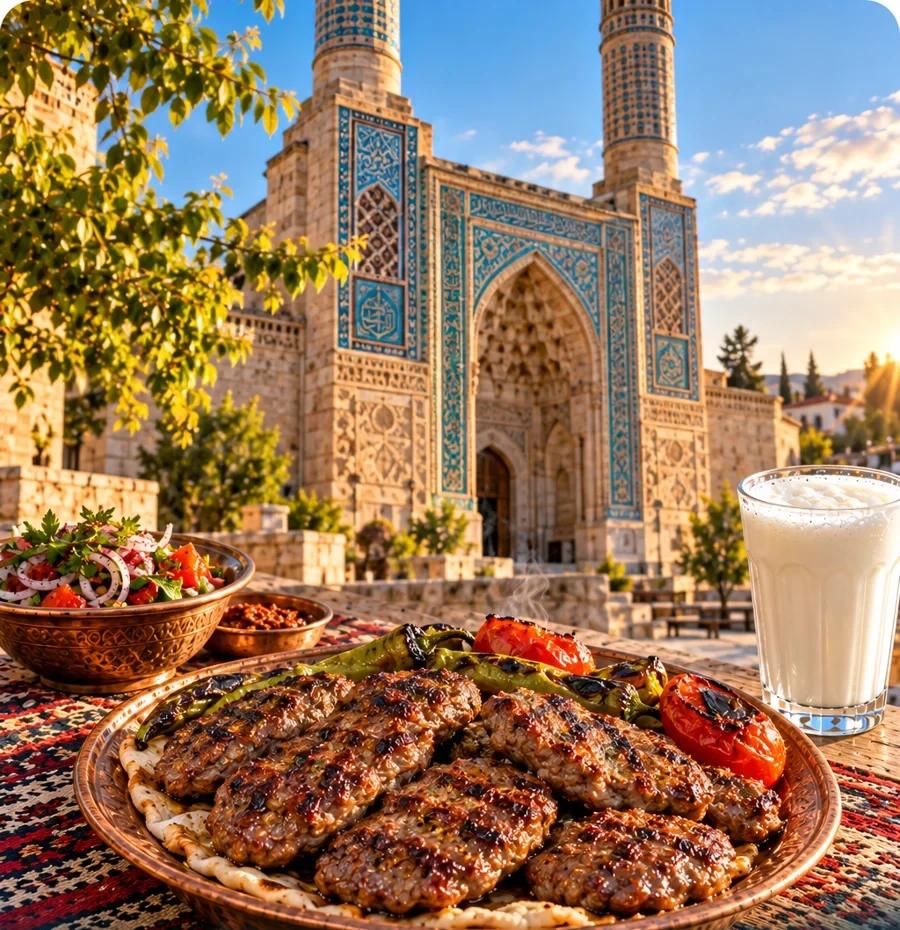
A high plateau, charcoal grills and a table of köfte and pilaf.
Explore preserved dairy, grains and greens alongside the city’s meat dishes.
Salt-seasoned grilled köfte
Beef and mutton seasoned only with rock salt, shaped into small flat ovals, grilled over oak charcoal and served on pide.
Skewers cooked by the hearth
Skewers of meat and vegetables hung upright on wires beside an open hearth to cook.
Wheat, lentil and peskütan soup
Cracked wheat and green lentils boiled with peskütan, then whisked until thick.
Rice with lamb and chickpeas
Rice cooked with lamb, onion, chickpeas, currants, allspice, pine nuts and butter.
Pickle and egg omelette
Pezik pickle fried with onions, then set with eggs into an omelette.
Slow-baked head
Heads slow-cooked in sealed pots set in the embers of a wood-fired stone oven.
Boiled stuffed bulgur köfte
Bulgur and beef dough filled with spiced kidney fat, boiled and served hot with apricot compote; from Altınyayla.
Recipes from this city are coming soon.
Air-dried beef cured with local rock salt and coated in çemen.
Guide not written yetA yogurt-like preserve made from fresh milk in spring and kept for winter.
Guide not written yetPickle of finely cut beet stalks, first blanched in hot water.
Guide not written yetNatural rock salt from Tuzlagözü in Zara, the only seasoning in Sivas köftesi.
Guide not written yetWinter preparation is a strong theme in the regional food account: dried grains, noodles, preserved dairy and pickles make a household pantry suited to long cold periods. Madımak also appears in local songs as well as cooking, linking food with cultural memory. The guide describes that association without giving plant-identification or foraging advice. District dishes and city bazaar foods retain their separate contexts.
Sivas köftesi is seasoned only with Zara rock salt and grilled over oak charcoal.
Spring milk becomes peskütan and beet stalks become pezik pickle, both cooked into winter dishes.
In Sivas, the madrasas tell the story of the city’s thirteenth-century Seljuk heritage most clearly. Gök Medrese, with its monumental marble portal and façade, reflects the character of that century. The Buruciye Madrasa, built under the Seljuk Sultan Gıyaseddin Keyhüsrev III, was founded solely for teaching physics, chemistry and astronomy. The surviving original feature of the Double Minaret Madrasa is its magnificent façade, and the two minarets rising above its portal have become a symbol of Sivas. At the Şifaiye Madrasa and Darüşşifa, patients were treated and medicine was also taught.
The city’s modern turning point came with the Sivas Congress, which met in September 1919. In Divriği, a district of the province, the Great Mosque and Hospital stand on the slopes below the castle. The mosque was founded by the Mengücekid emir Ahmed Shah, while the adjoining hospital was founded by his wife Turan Melek. Without a courtyard, the mosque gathers all its religious functions in an enclosed space, perhaps because of the harsh climate. Its richly carved portals contrast strongly with the unadorned interior walls.


