


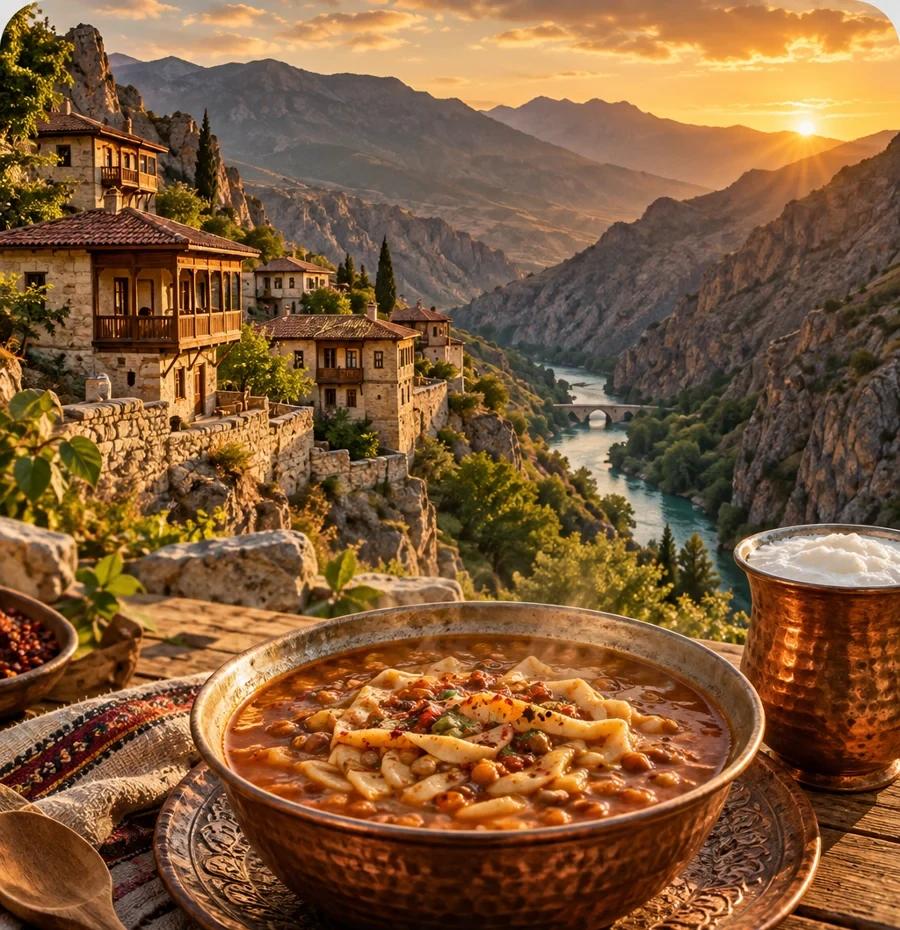
Kesme çorbası
Noodle soup with yogurt
Erişte noodles, minced meat, butter, onion, yogurt and spices, a fixture of Ramadan tables.
Eastern Anatolia
In Erzincan, recipes connect in places you might not expect. Kesme çorbası, which appears often on Ramadan tables, brings erişte noodles together with minced meat, butter, onion, yogurt and spices. For festivals and special days there is kelecoş, where lamb shares the pot with dried beans, chickpeas, wheat and lentils. On the sweet side, two recipes join hands. Erzincan kesme kadayıfı, its yufka cut finely by hand and layered with walnuts before meeting its syrup, is served together with Erzincan sütlacı, the local rice pudding with its oven-browned top. Travel on to Kemaliye and the district's dried mulberries meet walnuts in lök tatlısı, a dense sweet. At the savory end of the table waits Erzincan tulum peyniri, a cheese made from the milk of sheep grazing high mountain pastures. Start with a bowl of kesme çorbası, then follow the trail to the kadayıf resting on a pudding and on to lök made with Kemaliye's mulberries; in Erzincan, each recipe leads you to the next.
Last updated:
Mountain pastures, vineyards and a cut of tulum cheese.
Explore compressed curd cheese alongside fruit, honey and noodle-based cooking.
Noodle soup with yogurt
Erişte noodles, minced meat, butter, onion, yogurt and spices, a fixture of Ramadan tables.
Lamb with pulses and wheat
Lamb cooked with dried beans, chickpeas, wheat and lentils for festivals and special days.
Yeasted dough strips with lamb
Soft yeasted dough cut into strips and mixed with lamb.
Rice with dried green beans
Rice cooked with dried green beans, or fresh ones when in season.
Apricots with hot butter
Boiled apricots under hot butter, sometimes topped with walnuts, hazelnuts or peanuts.
Meat and quince stew
Cubes of meat cooked with quince and spices, a sweet-and-sour dish from Kemaliye.
Hand-cut kadayıf with walnuts
Yufka from a yogurt and milk dough cut finely by hand, layered with walnuts, baked and soaked in syrup.
Rice pudding with kadayıf
Oven-browned rice pudding served topped with kesme kadayıf.
Mulberry and walnut sweet
A dense sweet of dried mulberries and walnuts from Kemaliye.
Recipes from this city are coming soon.
Cheese made from the milk of sheep grazing high mountain pastures.
Guide not written yetA large-berried, slightly sour grape from Üzümlü.
Guide not written yetHoney from the thyme and tragacanth flora around Refahiye.
Guide not written yetMulberries from Kemaliye, dried for lök.
Guide not written yetSalt from salty spring water left to settle in ponds at Kemah.
Guide not written yetLarge white dried beans that cook easily.
Guide not written yetCopper working connects Erzincan with the making of trays, vessels and other household objects. The Ministry’s craft account describes hammering and engraving, with skills learned through master–apprentice relationships. It also records pressures on the trade, rather than presenting it as unchanging. This material culture belongs beside food: vessels have practical uses as well as decorative surfaces. The work of a maker can be part of the story of a table without claiming that a particular serving arrangement is universal.
Erzincan’s tulum cheese is made from the milk of sheep grazing mountain meadows.
Kelecoş and kesme çorbası fill tables at festivals and during Ramadan.
A good way to approach Erzincan is through the mountains around it. The city is surrounded by mountains, and the slopes of Munzur Mountain and the Fırat (Euphrates) River are among the places that stand out in the province’s natural character. Its past is not confined to the present-day center, either. Outside the city center stands Altıntepe, an old structure that hosted both Urartian and Byzantine civilizations. To understand Erzincan’s story, it helps to look beyond the city itself.
In the center, the mark of earthquakes is hard to miss. Erzincan lost most of its historical monuments to major earthquakes. Today’s Clock Tower was built to replace an earlier tower that fell in the 1939 earthquake. Çadırcı Hamamı is one of the city’s classic Ottoman structures. In Kemaliye, the outer doors of traditional houses carry two different knockers: one for women and one for men. The sound of the knocker tells the household whether a woman or a man should greet the visitor. The Stone Road, linking Kemaliye with Divriği, was opened by local people who carved through the rocks of the Dark Canyon.


