


Safranbolu lokumu
Safranbolu Turkish delight
Turkish delight made fresh in flavors such as hazelnut, pistachio, rose and saffron.
Black Sea Region
In Karabük, saffron does more than give Safranbolu its name; it colors the desserts too. Zerde, rice thickened with saffron water and sugar, is served cold at feasts and after memorial services. In Safranbolu kıtırı, saffron meets bran, walnuts or hazelnuts and cinnamon in slices that go through the oven twice. On the savory side, perohi brings a softer texture: triangles of dough filled with strained yogurt and mint, finished with hot butter. Çullu börek, a wedding dish, pairs griddle-baked yufka with butter and browns it over embers. In Eflani, hindi bandırması brings griddle bread dipped in the rich broth of a boiled turkey together with its pulled meat. Saffron returns among the local products as deep red threads grown around Safranbolu and picked in autumn, alongside flower honey from the linden forests of Yenice. Start with a spoonful of saffron-colored zerde, then set off for Eflani for its turkey and Yenice for its honey.
Last updated:
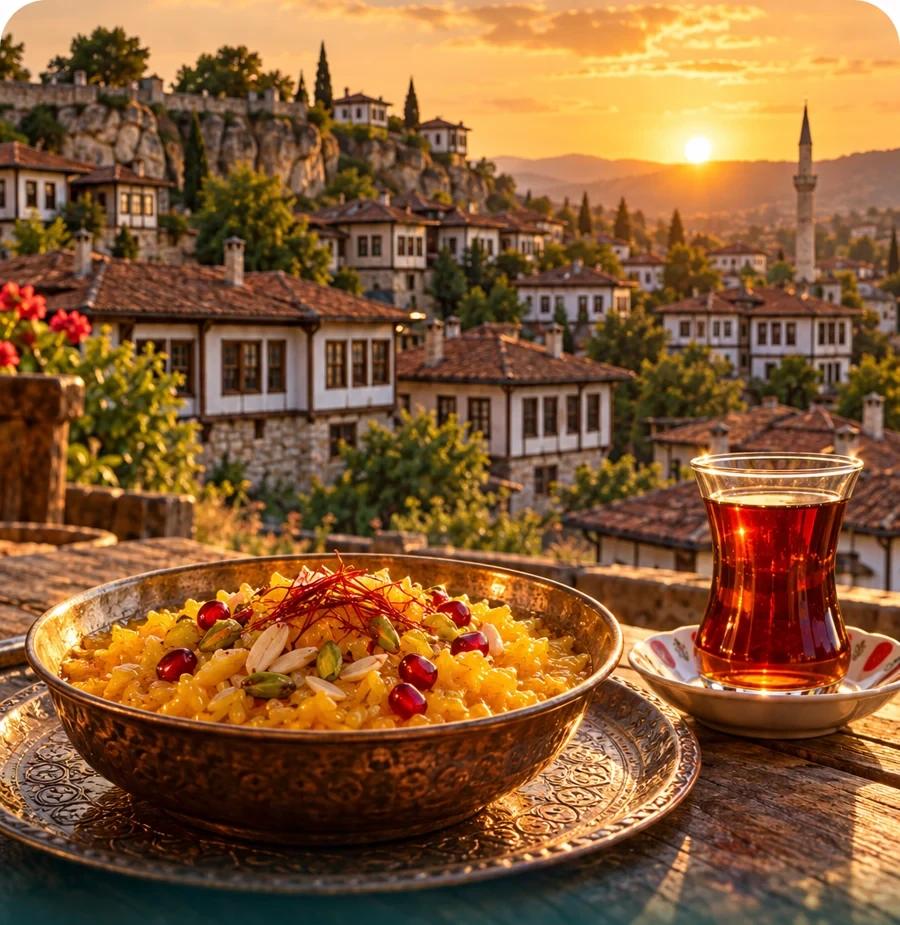
Timbered houses, saffron fields and trays of lokum.
Explore soft confectionery, boiled filled dough and a district walnut sweet as different preparations.
Safranbolu Turkish delight
Turkish delight made fresh in flavors such as hazelnut, pistachio, rose and saffron.
Yogurt-filled dumplings
Squares of dough filled with strained yogurt and mint, folded into triangles, boiled and drizzled with hot butter.
Saffron rice pudding
Rice cooked with saffron water and sugar until thick, served cold at feasts and after memorial services.
Walnut crumbles in syrup
Small balls of flour and egg roasted in butter with walnuts, then soaked in syrup.
Butter-baked yufka börek
Griddle-baked yufka cut into strips, mixed with butter, enclosed in more dough and browned over embers; a wedding dish.
Walnut and egg-white helva
Sugar syrup beaten with egg whites and folded with walnuts, made in Yenice for feast days.
Turkey with broth-soaked bread
Griddle bread dipped in the rich broth of a whole boiled turkey and served under its pulled meat.
Saffron and nut rusks
Twice-baked slices of dough with bran, nuts, cinnamon and saffron.
Recipes from this city are coming soon.
Deep red saffron threads grown around Safranbolu and picked in autumn.
Guide not written yetFlower honey from the linden forests of Yenice.
Guide not written yetLarge, thin-skinned, yellowish-green table grapes.
Guide not written yetA local tomato, flattened and lobed, juicy and thin-skinned.
Guide not written yetWild mushrooms gathered in autumn for dishes and börek.
Guide not written yetSafranbolu’s craft and market areas connect buildings with work. Shoemaking and metalworking associations remain visible in the names and histories of its bazaars. Domestic rooms, cupboards and decorated interiors add a household scale to the architectural story. The wider province includes Yenice’s forest landscape and Eskipazar’s Hadrianapolis remains. These different settings make district-level detail especially useful in a food and culture guide.
Saffron gives Safranbolu its name and colors zerde and kıtırı.
Lokum, zerde and Yenice walnut helva are made for feasts and visits.
North of the provincial center of Karabük lies Safranbolu, which from the 13th century until the arrival of the railway in the early 20th century was an important caravan station on the main East–West trade route. That trade shaped the town itself. Çukur, in the lower part of town, has a triangular shape defined by two rivers, with the market place at its center surrounded by the houses and workshops of craftsmen. Kıranköy, formerly a non-Muslim district, followed a different pattern: artisans and tradesmen lived above their shops, and the houses were built of stone rather than the wood used in Çukur. On the northwest slope, Bağlar, the Vineyards, with its single houses set in large gardens, served as the town’s summer resort.
When the caravan trade collapsed, Safranbolu’s proximity to the Karabük steel works gave it a new socio-economic role. The province’s history reaches further back, too. Near Eskipazar, the ruins of ancient Hadrianopolis include remnants of cellars, baths and water channels; the city was one of the important centers of Paphlagonia during the Roman and Byzantine periods.


