


Çankırı sarımsaklı et
Mutton with whole garlic
Mutton browned and slow-cooked with shallots, tomato paste and garlic cloves left in their inner skin so they keep their shape.
Central Anatolia
Salt is a good place to start with Çankırı’s cooking, because the local rock salt seasons doughs, soups and meat dishes. Sarımsaklı et is known for its garlic: the cloves keep their thin inner skin, so they hold their shape beside mutton slow-cooked with shallots and tomato paste. In yaren güveci, lamb cooked in an earthenware pot meets fried eggplant in layers. Yet much of this table’s range comes from wheat and dough. In cimcik hamuru çorbası, bow-shaped pieces of egg dough meet garlic yogurt and red pepper butter. Yoka ekmek muskası, usually eaten at breakfast, wraps thin yoka bread around dried mince and küpecik cheese, a cheese ripened pressed into earthenware jars, and comes straight from the pan. For something sweet there is höşmerim, flour roasted in butter and cooked into crumbly grains, served hot with honeycomb. A journey that begins with rock salt ends, fittingly, with warm höşmerim beside a piece of honeycomb.
Last updated:
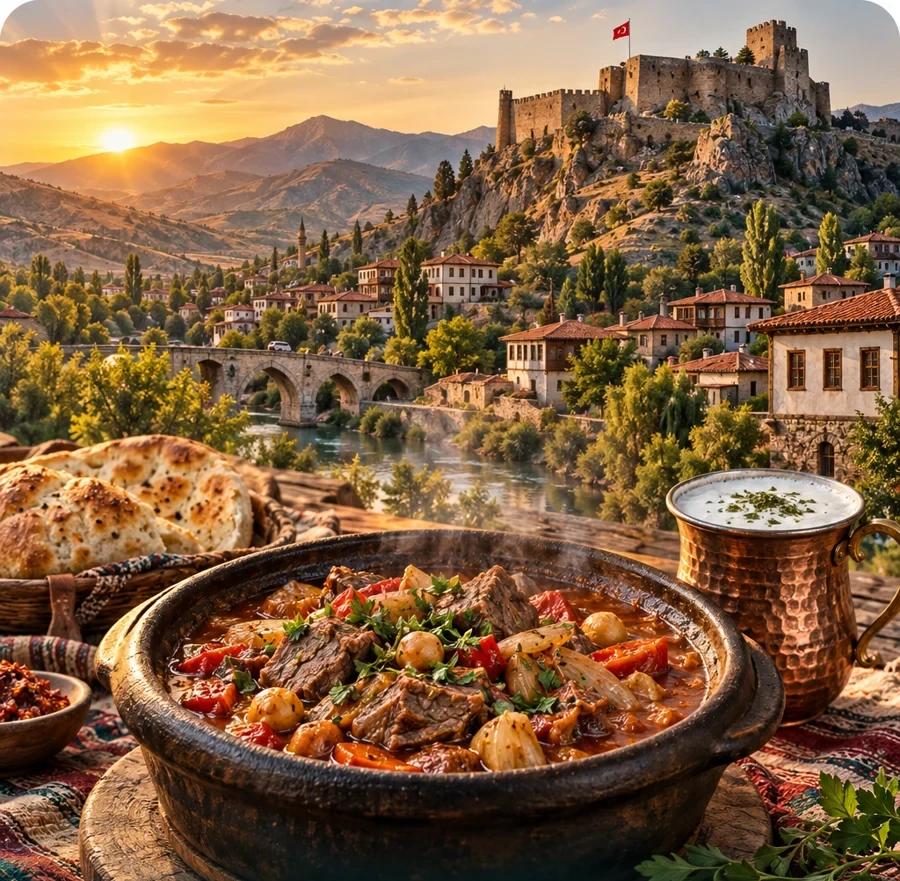
Hills, rock salt and a pot of garlic meat.
Explore fruit growing alongside the grain-based dishes of an inland provincial pantry.
Mutton with whole garlic
Mutton browned and slow-cooked with shallots, tomato paste and garlic cloves left in their inner skin so they keep their shape.
Lamb and eggplant casserole
Lamb cooked in an earthenware pot with onion, garlic, peppers and tomato, layered with fried eggplant and finished in the oven.
Noodle and lentil soup
Tiny squares of tutmaç dough cooked with green lentils and garlic yogurt, topped with butter, mince, mint and red pepper.
Bow-tie dumpling soup
Small squares of egg dough pinched into bows, boiled and mixed with garlic yogurt, then topped with egg and red pepper butter.
Folded thin bread with cheese
Thin yoka bread folded into a triangle around küpecik cheese and dried mince and pan-fried, usually for breakfast.
Layered triangle bread
Yeast dough rolled thin, brushed with fat and folded into a layered triangle, then baked in a stone oven.
Egg sponge in syrup
A light sponge of whipped egg whites, yolks and a little flour, baked, sliced and soaked in syrup.
Buttery flour sweet with honey
Flour roasted in butter and cooked with salted water into crumbly grains, served hot with honeycomb.
Recipes from this city are coming soon.
Rock salt from Çankırı, used throughout the local cooking.
Guide not written yetA local cheese pressed into earthenware jars to ripen.
Guide not written yetFlower honey from the Kurşunlu district.
Guide not written yetCherries grown in the Eldivan district.
Guide not written yetYâran gatherings connect Çankırı with the wider tradition of sohbet meetings. UNESCO describes these meetings as places where conversation, music, dance and oral knowledge are passed between generations. The recognition concerns a social practice, not a certification of a particular dish. Shared meals can be part of this setting, but the social relationships matter as much as the menu. Local heritage spaces help explain these practices without implying that every resident participates in the same way.
Tarhana, tutmaç, yoka bread and many soups are built on wheat and wheat products.
Local rock salt seasons doughs, soups and meat dishes, and küpecik cheese ripens in earthen jars.
A good way to get to know Çankırı is to start at the castle on the hill overlooking the whole city. It holds a plain tomb where the Seljuk commander Karatekin Bey, conqueror of Kastamonu, Sinop and Çankırı, lies with his wife Meryem Hatun and their two children. One of the city’s important surviving Seljuk buildings is the Cemaleddin Ferruh Darülhadisi, commonly known as Taş Mescit. Built in the thirteenth century beside a hospital, it was a place where the hadith sciences were taught. One stone on the building depicts two snakes winding around each other, the image used today as the symbol of medicine.
The province lies in the transition zone between the Black Sea and Central Anatolia regions. The Ilgaz Mountains form a natural border between Çankırı and Kastamonu, while the Köroğlu Mountains run parallel to them to the south. Below ground there is another story. Tuz Cave was formed by excavations for salt mining in rock-salt reserves, and these deposits are believed to have been used since the Hittite period.


