


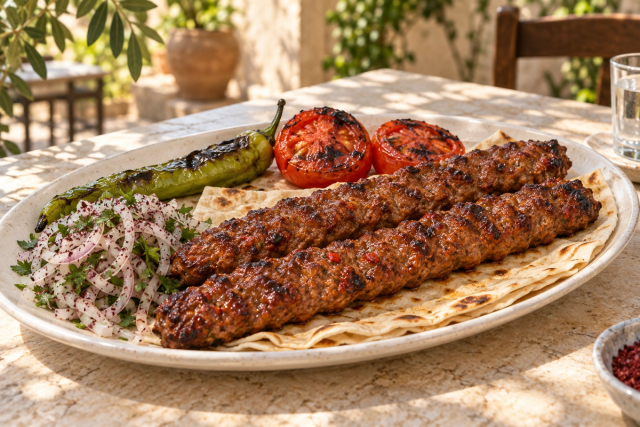
Adana-Style Lamb Skewers
Hand-chopped lamb and tail fat grilled on flat skewers, with warm flatbread, charred vegetables and sumac onions.
Mediterranean Region
The story of Adana kebabı begins with a knife called a zırh: male lamb and tail fat are minced by hand with it, seasoned with salt and red pepper, then pressed onto skewers and grilled over flameless charcoal. Drunk alongside the kebab, Adana şalgamı is a sharp red drink made by fermenting black carrots and turnips in water. As evening falls, şırdan, a street food made from lamb abomasum, is sold on street corners across the city. Cool sweets answer the heat as well: bici bici, eaten mainly in summer, tops starch jelly with shaved ice, powdered sugar, rose water and syrup. Taş kadayıfı starts as a porous round cooked on one side on a griddle, folded over crushed walnuts, fried and dipped in syrup. After the charcoal and the syrup, carry on with Kozan’s oranges, juicy, with few seeds and deep orange flesh, bringing the province’s citrus to the table.
Last updated:
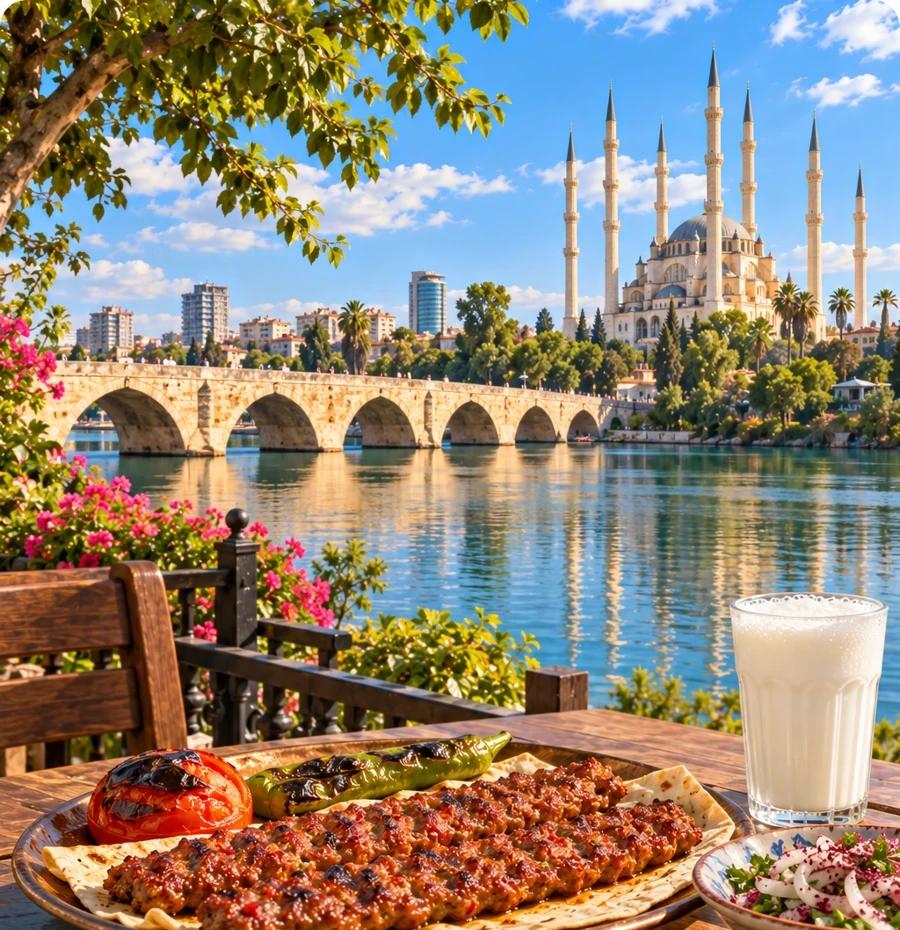
Kebab smoke, citrus groves and the wide Çukurova plain.
Hand-chopped lamb and tail fat grilled on flat skewers, with warm flatbread, charred vegetables and sumac onions.
Fermented black carrot drink
Black carrots and turnips fermented in water to make a sharp red drink served with kebab.
Lamb abomasum street food
A street food made from lamb abomasum, sold on corners across Adana in the evening.
Stuffed bulgur meatballs
Bulgur shells filled with spiced meat, boiled in salted, lemony water and served hot.
Soup with two kinds of köfte
Stuffed köfte (the mothers) and tiny bulgur balls (the daughters) cooked in broth with chickpeas and pepper paste.
Liquorice root drink
A cold drink made by steeping liquorice root in water and straining it.
Starch jelly with shaved ice
Starch jelly topped with shaved ice, powdered sugar, rose water and syrup, eaten mainly in summer.
Walnut pastry in syrup
Rolled-out dough sprinkled with walnuts, rolled and cut, then fried and dipped in syrup; served at weddings and holidays.
Fried rings in syrup
Semolina and flour dough piped into hot oil in rings and dipped in syrup, crisp outside and soft inside.
Walnut-filled fried pancake
A porous round of batter cooked on one side, folded over crushed walnuts, fried and dipped in syrup.
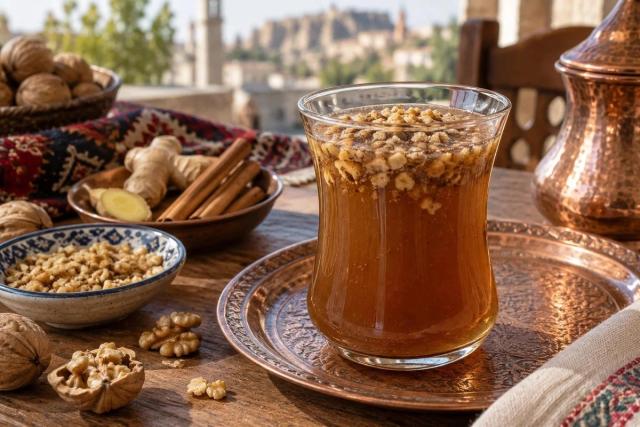
A warm spice infusion with galangal, ginger, cinnamon and cloves, topped with walnuts. In Adana, kaynar is associated with visits celebrating a new baby. That cultural association does not establish a medical or lactation benefit; this is a culinary serving recipe.
Juicy oranges from Kozan with few seeds and deep orange flesh.
Guide not written yetOlive oil from Ceyhan.
Guide not written yetWatermelon grown in Adana.
Guide not written yetPeanuts grown in Adana.
Guide not written yetPeppers grown around Karaisalı.
Guide not written yetThe Orange Blossom Carnival connects citrus to contemporary city life. Film, theatre and food festivals are other parts of Adana’s cultural calendar. A guide to the city should include that living culture as well as its much better-known kebab.
Adana kebabı is minced by hand with a zırh knife and grilled over flameless charcoal.
Fermented şalgam goes with kebab, while aşlama and bici bici are served cold.
Adana’s story takes tangible form at the Taş Bridge, which crosses the Seyhan River and links the Seyhan and Yüreğir districts. Dating from the Roman Imperial Period and regarded as one of the city’s important symbols, the bridge was built, according to an inscription in the Adana Archaeology Museum, by an architect named Auxentios. At Tepebağ Mound in Seyhan district, ancient ruins share the ground with the Tepebağ Houses, examples of Ottoman civil architecture. A statuette of the nurse Sitsnefru from Egypt’s Middle Kingdom, now exhibited at The Metropolitan Museum of Art in New York, was found in this very mound.
The Yağ Mosque began, according to its inscription, as a Crusader church built in the name of Saint Jacque, and was converted into a mosque by Ramazanoğlu Halil Bey. At Misis, within Yüreğir district, the ancient city was established on a limestone ridge facing the Ceyhan River and on both of its banks. The nine-arched bridge built there in the 4th century under the Roman Emperor Constantius to cross the river was later repaired in the 6th century by the Byzantine Emperor Justinian I.


