


Maraş dondurması
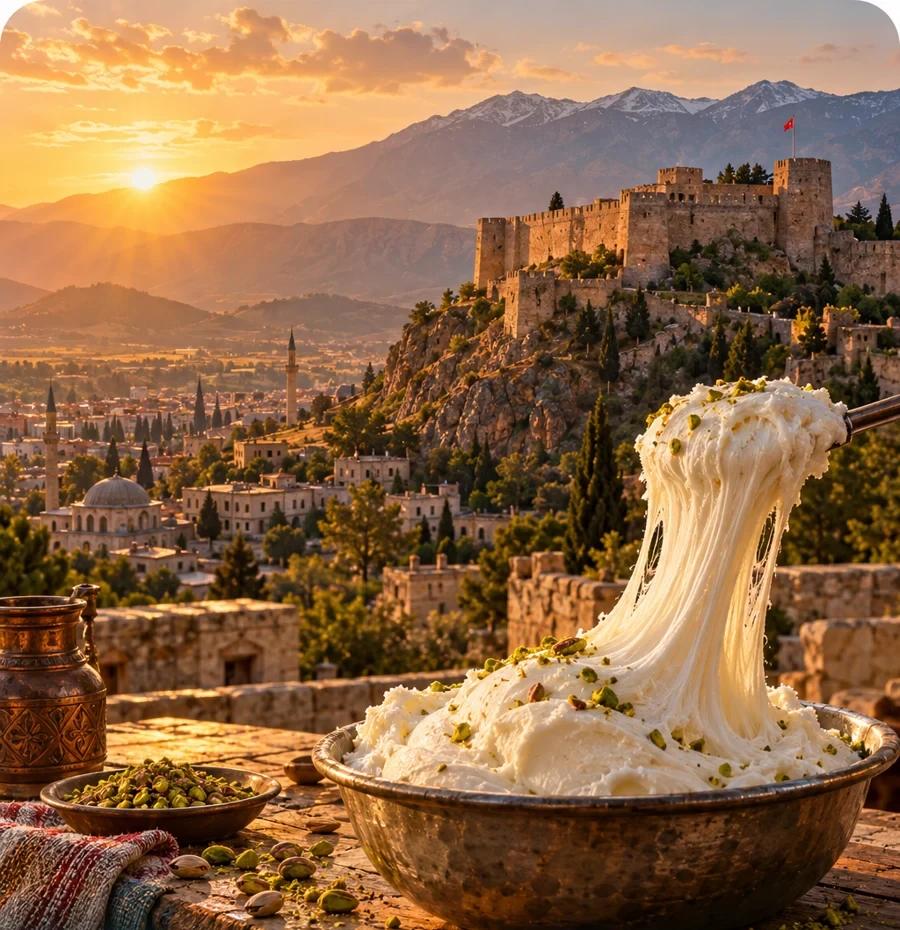
Goat’s-milk salep ice cream
Goat’s milk boiled with salep and sugar, stirred until stretchy, rested and then chilled.
Mediterranean Region
Maraş
Kahramanmaraş eats in a steady back-and-forth between sour and sweet, pepper flakes and walnuts. One face of the sweet side is Maraş dondurması, goat’s milk turned stretchy with salep and sugar. The sour side arrives by the spoonful: ekşili çorba brings dövme wheat, lentils, chickpeas, vegetables and meat together and gets its tang from sumac. That sourness has its source in sumak ekşisi akıtı, thickened in the sun. İçli köfte, bulgur shells around a filling of minced meat and walnuts, comes to the table either fried or boiled. Maraş çöreği, a nigella-seed dough rolled thin with a grooved hornbeam pin, comes out of a stone oven and is eaten especially during Ramadan. When the şıra season comes, thin sheets of grape must are folded into triangles of samsa around ground walnuts. Thin-skinned Maraş peppers, sun-dried and crushed into flakes, and walnuts from Çağlayancerit hold the two ends of this kitchen. Following a spoonful of dondurma to the samsa of şıra season, and on to Çağlayancerit’s walnuts, is a good way to get to know Kahramanmaraş more closely.
Last updated:
Copper bazaars, autumn vineyards and a table of tarhana.
Explore yogurt and wheat in a crisp dried form, then compare dairy sweets and preserved fruit products.
Goat’s-milk salep ice cream
Goat’s milk boiled with salep and sugar, stirred until stretchy, rested and then chilled.
Goat or sheep head soup
Goat or sheep head meat boiled into a soup with pepper, red pepper paste, garlic and sumac.
Sour wheat and lentil soup
Dövme wheat, lentils and chickpeas cooked with vegetables and meat, then soured with sumac.
Bulgur shells with walnut filling
Bulgur shells filled with fried minced meat, onion, pepper and walnuts, then fried or boiled.
Stuffed dried vegetables
Dried aubergines, peppers or courgettes softened in boiling water and stuffed with spiced minced meat.
Nigella-seed flatbread
Thin rounds of nigella-seed dough, rolled with a grooved hornbeam pin and baked in a stone oven, eaten especially in Ramadan.
Grape-must and walnut sweet
Thin sheets of dried, thickened grape must folded into triangles around ground walnuts.
Sun-thickened grape drink
Fresh grape juice thickened in the sun and stirred into water by the spoonful.
Recipes from this city are coming soon.
Thin-skinned peppers dried in the sun and crushed into flakes.
Guide not written yetWalnuts grown around Çağlayancerit.
Guide not written yetGarlic from the Koçovası plain at Afşin.
Guide not written yetSumac berries soaked in water, strained and thickened in the sun into a sour concentrate.
Guide not written yetDövme wheat and yogurt spread thin and dried, cooked as soup or eaten dry and crisp.
Guide not written yetCopper working is a documented local craft. The Ministry describes the shaping and working of vessels and other objects, connecting skilled metalwork with domestic use and trade. The craft has adapted to changing techniques and demand. Looking at the making of a vessel offers a useful companion to the food served in it, without assuming that every household uses the same equipment or follows one unchanging tradition.
Maraş ice cream is made from goat’s milk, salep and sugar, stirred until it turns stretchy.
Each autumn grape must becomes pekmez, pestil, samsa and walnut sucuk for winter.
Kahramanmaraş’s past can be traced at the castle on a hill in the city center, a hill that drops steeply on its southern side and slopes gently to the north. Built in the Late Hittite Period, the castle was repaired and extended under a long succession of rulers, from the Assyrians and Romans to the Seljuks and Ottomans. Among the finds from excavations at the castle is the Maraş Lion, which, according to the writer Evliya Çelebi, stood at the castle’s gate entrance in the 17th century. After the Romans conquered the city, it was renamed Kaiseria Germanicia. The mosaics found at Germanicia are understood to belong to the Late Roman and Early Byzantine periods.
The city’s commercial life can be followed through its bazaars. The foundations of historic markets such as the Kapalı Çarşı, Saraçhane, Bakırcılar and Demirciler date back to the time of the Beylik of Dulkadir, and these bazaars retain their economic vitality. East of the Kapalı Çarşı, Taşhan was built as an inn and integrated with the bazaar complex, giving arriving caravans a place to unload their goods and stay in the city.


