


Tekirdağ köftesi
Grilled beef köfte
Beef kneaded with stale bread, onion and garlic, rested before shaping and grilled over charcoal.
Marmara Region
In Tekirdağ, the table traces a route from the grill to dessert. At the start stands Tekirdağ köftesi, beef brought together with stale bread, onion and garlic and cooked over charcoal, and right beside it ciğer sarma, a liver pilaf wrapped in lamb caul fat. Move on to dessert and cheese steps forward. In Tekirdağ peynir helvası, fresh unsalted cheese with flour, eggs and sugar reaches a stringy consistency, while Hayrabolu tatlısı, made with semolina and unsalted cheese, is sold either dried or soaked in syrup. Bulama comes from another transformation altogether: grape must boiled into molasses over a wood fire is beaten with çöven root into a cream-colored sweet with a thick, kaymak-like texture. Malkara's hard, cylindrical eski kaşar, ripened in cool stores, is another reminder of the place cheese holds here. After a spoonful of bulama, the road opens towards Şarköy, with its thick, aromatic olive oil and its Yapıncak, Şensu and Papazkarası grapes.
Last updated:
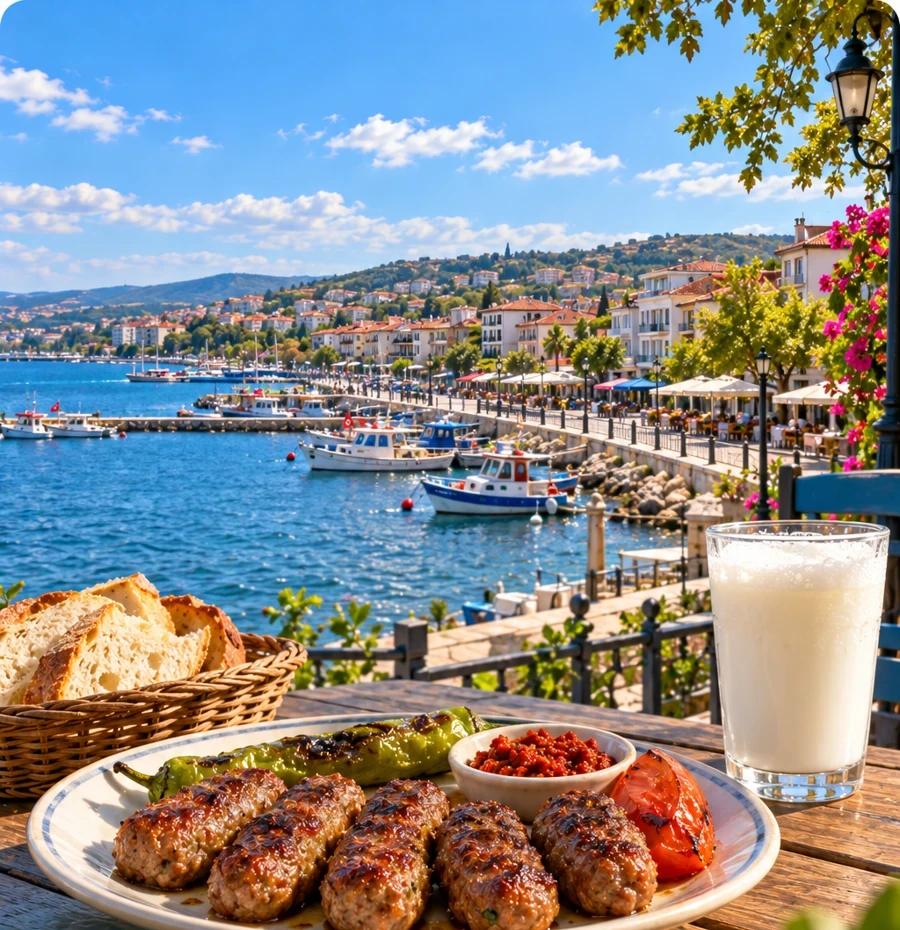
The Marmara shore, vineyards and a plate of grilled köfte.
Follow a köfte meal into dairy, grape and olive traditions beyond the city.
Grilled beef köfte
Beef kneaded with stale bread, onion and garlic, rested before shaping and grilled over charcoal.
Fresh cheese halva
Fresh unsalted cheese cooked with flour, eggs and sugar until it turns stringy.
Cheese and semolina dessert
A dessert of semolina and unsalted cheese, sold baked and dried or soaked in syrup.
Whipped grape molasses
Grape must boiled down to molasses over a wood fire, then beaten with çöven root until thick and cream-colored.
Pilaf wrapped in caul fat
Rice pilaf with liver wrapped in lamb caul fat and cooked.
Recipes from this city are coming soon.
Hard, cylindrical aged kaşar from goat, sheep and cow milk, ripened in cool stores.
Guide not written yetThick, aromatic olive oil from Şarköy.
Guide not written yetGrapes such as Yapıncak, Şensu and Papazkarası grown around Şarköy.
Guide not written yetSemi-dried beef sausage made by dry curing in İnecik.
Guide not written yetDomestic architecture, museum collections and district food production offer complementary views of the province. Malkara is associated with dairy, Şarköy with vineyards and olives, and Velimeşe with boza. The vineyard account includes local grape names as well as international wine varieties. These agricultural connections are part of a changing living landscape, rather than proof that every modern product follows an unchanged ancient method.
Fresh unsalted cheese is the base of peynir helvası and Hayrabolu tatlısı.
Şarköy gives olive oil and grapes, and grape must is boiled down and beaten into bulama.
Tekirdağ’s story begins with its place on the route between Edirne and İstanbul; during the Ottoman period the city became an important summer resort. One of the clearest marks of that era is the Rüstempaşa Complex, built in the 16th century under the Grand Vizier Damat Rüstem Pasha and bearing the signature of Mimar Sinan. Its bedesten, or covered bazaar, served for centuries as the city’s trade and financial hub. On the streets overlooking the sea, 18th- and 19th-century houses that have survived urbanisation can be seen, some of wood and others of stone or brick.
One of these houses has a link to Hungarian history. The three-storey traditional Ottoman house was home to Ferenc Rákóczi II, hero of Hungarian liberation, and was restored by the Hungarian government and turned into a museum. On the province’s Marmara coast, Heraion Teikhos reaches much further back. Surface surveys and excavations show that this Thracian settlement was continuously inhabited for more than three millennia, with roots reaching back through the Bronze and Iron Ages.


