


Cizre meyresi
Yogurt and bulgur soup
Bulgur cooked slowly with whisked yogurt, squash and wild mint, sometimes with egg; eaten hot or cold, often at breakfast.
Southeastern Anatolia
The Şırnak table is best read district by district, since each one brings its own flavor. In Beytüşşebap, the whole point of sehleber kebabı is its simplicity: boneless lamb or goat cooked between heated flat stones and seasoned with nothing but rock salt. Soryaz, a wild mountain allium gathered and brined each spring, reaches you fried with onions and eggs and served hot. Şımşıpe, with its dried peppers, dried eggplant and squash stuffed with minced meat and rice and cooked with vine leaves and beetroot, recalls a larder. Move on to Cizre and the day often begins with meyre, a bulgur dish made with whisked yogurt, squash and wild mint that is eaten either hot or cold. The same town’s bırınczer is a thick rice pudding colored with saffron, dusted with cinnamon and served cold. From there, turn back towards the flower honey of a high valley in Beytüşşebap, and to dergul tahini, made from Kumçatı sesame ground on stone in a water-powered mill.
Last updated:
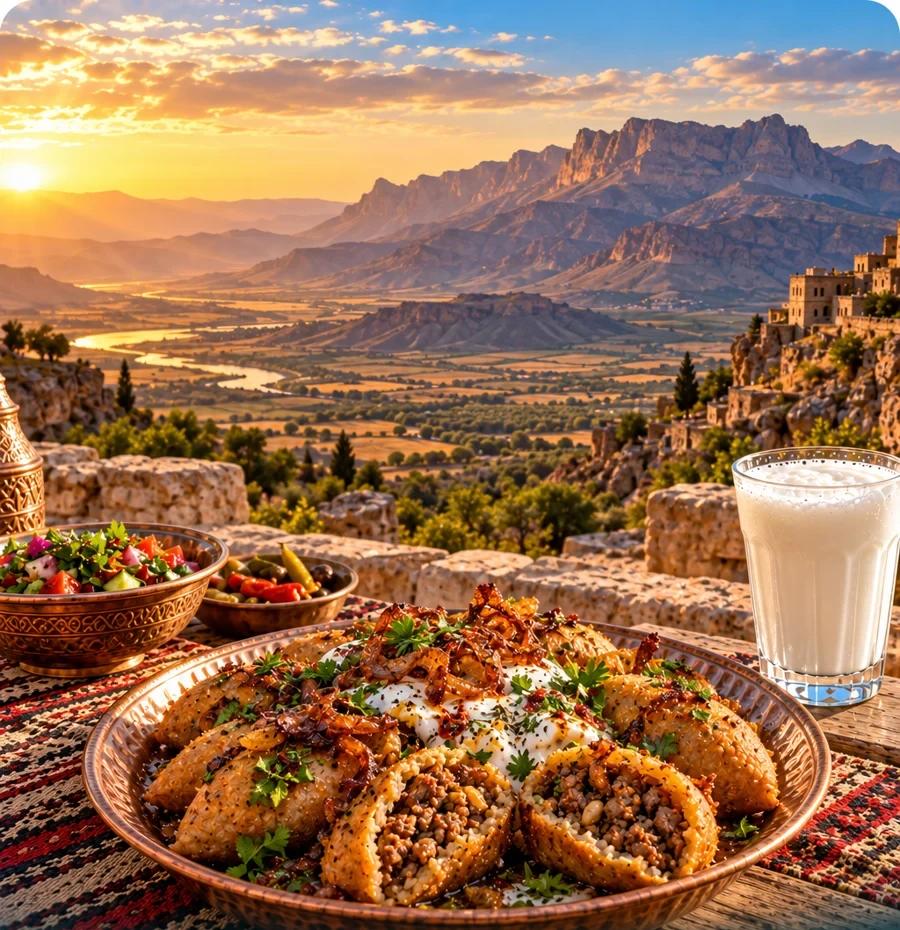
Mountain valleys, the Tigris and a table of bulgur, yogurt and wild herbs.
Explore bulgur shells, yogurt-based soup and district sweets as separate preparations.
Yogurt and bulgur soup
Bulgur cooked slowly with whisked yogurt, squash and wild mint, sometimes with egg; eaten hot or cold, often at breakfast.
Wild allium with egg
Brined soryaz, a wild mountain allium, fried with onions and eggs and served hot.
Boiled and fried içli köfte
Bulgur shells filled with onion and minced meat, boiled, then dipped in egg and fried.
Mixed stuffed vegetables
Dried peppers, dried eggplant and squash stuffed with minced meat and rice, cooked with vine leaves and beetroot.
Pilaf baked in pastry
Spiced chicken and almond pilaf wrapped in a thin dough of egg and oil and baked.
Meat cooked between stones
Boneless lamb or goat cooked between heated flat stones and seasoned only with rock salt.
Saffron rice pudding
Rice cooked thick with sugar, colored with saffron or turmeric, dusted with cinnamon and served cold.
Walnut and semolina sweet
Semolina, flour and crushed walnuts cooked in syrup until chewy, set with walnut halves and cut into diamonds; made especially in Ramadan.
Fried walnut pastry in syrup
Thin saç bread topped with walnuts, sugar and butter, fried in hot oil and soaked in syrup.
Recipes from this city are coming soon.
Flower honey from a high valley in Beytüşşebap, sold strained or in the comb.
Guide not written yetTahini of sesame grown in Kumçatı, lightly roasted and ground in a water-powered stone mill.
Guide not written yetA yellow, thin-skinned fig with soft pinkish-red flesh, harvested from July to October.
Guide not written yetThe story of Mem û Zîn is closely connected with Cizre and the site at Abdaliye Medrese. Ahmed-i Hani’s literary treatment gives the story a place in Kurdish cultural memory. A literary and commemorative association does not require treating every narrative detail as verified biography. Provincial food traditions likewise retain local names. Cizre’s sweets and Beytüşşebap’s honey association reflect different settings within the province rather than a single undifferentiated city cuisine.
Cizre is known for cold saffron bırınczer, walnut luzine and meyre of yogurt and bulgur.
Beytüşşebap’s high valleys give honey and stone-cooked sehleber, and wild soryaz is gathered and brined each spring.
An important part of Şırnak province’s historic heritage lies not in the provincial center but in Cizre, a district on the banks of the Tigris. The ruins of Cizre Castle, made up of an outer and an inner castle, show a building process stretching from the Roman and Byzantine periods to the era of the Mosul Atabegs and the Cizre Beys. Inscriptions on the town’s Great Mosque link it to the Mosul Atabeg era. The Kırmızı Medrese, or Red Madrasa, takes its name from the red bricks unique to Cizre and holds the tomb of the scientist and poet Sheikh Ahmed Al-Jazeri.
The province’s mountainous areas tell another story. Kasrik Gorge, on the Cizre–Şırnak highway, introduces the province’s mountainous terrain. This deep valley served as a strategic passage in the Assyrian, Persian and Roman periods. In Beytüşşebap district, Kato Mountain has long been known for its difficult passes.


