


Mardin kaburga dolması
Rice-stuffed lamb ribs
A lamb rib stuffed with spiced rice pilaf, sewn shut, simmered and then roasted, made for religious holidays, weddings and special occasions.
Southeastern Anatolia
In Mardin, special days decide when certain dishes reach the table. Both kaburga dolması, a lamb rib filled with spiced rice pilaf, and firkiye, which brings fatty lamb together with spring onions and unripe green apricots and is served hot with lemon juice, are cooked for religious holidays, weddings and other special occasions. Ikbebet, with its shell of fine bulgur kneaded with meat and its filling of minced meat, onion and spices, arrives either boiled or fried. The rings of butter-enriched kiliçe, spiced with nigella, mahlab and cinnamon, carry the most intriguing story: they are baked for holidays, engagements, weddings, Christmas, Easter and funerals, each time in a shape of its own. On the sweet side waits harire, a pudding made from grape molasses and served chilled with walnuts. Two names stand out in the pantry: amber-yellow Mardin bulgur, made mainly from durum wheat, and Derik’s Halhalı olives, small-pitted and firm-fleshed. To begin getting to know Mardin, look at the shape of a kiliçe ring and ask which day it was baked for.
Last updated:
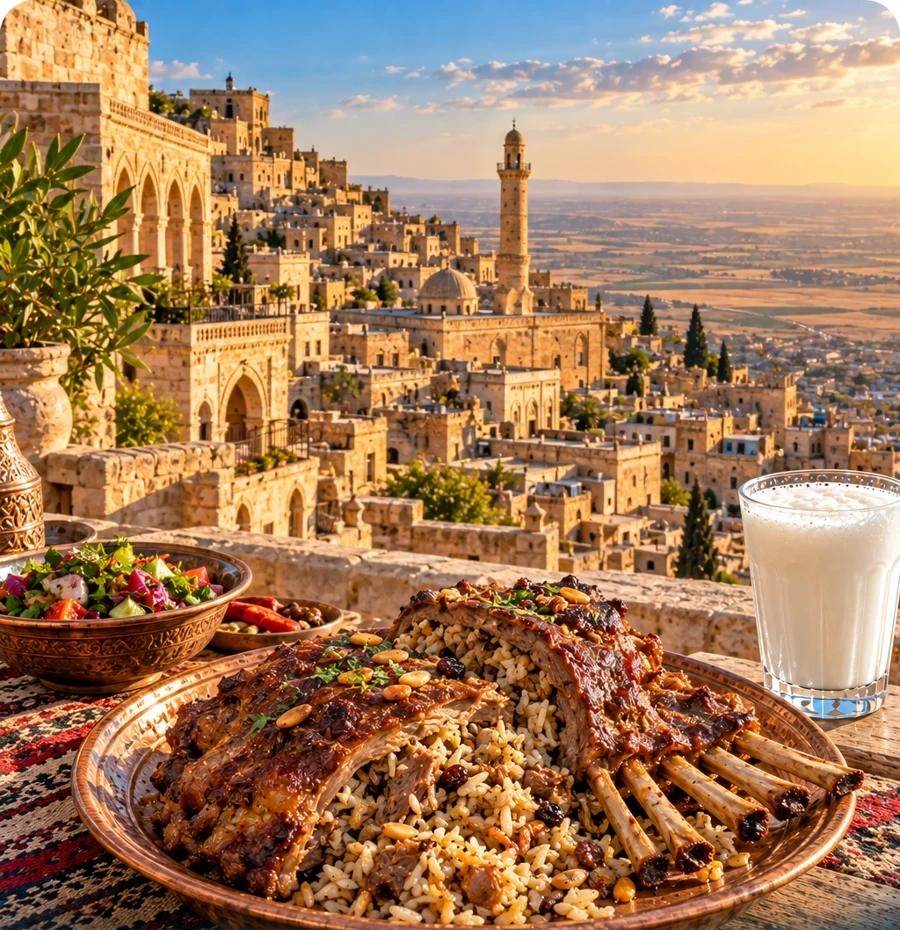
Stone houses and a festive stuffed lamb rib.
Explore contrasting dumpling preparations, almond sweets and the small-cup coffee tradition.
Rice-stuffed lamb ribs
A lamb rib stuffed with spiced rice pilaf, sewn shut, simmered and then roasted, made for religious holidays, weddings and special occasions.
Stuffed bulgur meatballs
Shells of fine bulgur kneaded with meat, filled with minced meat, onion and spices, then boiled or fried.
Beef and lamb skewers
Diced beef and lamb with tail fat and green pepper, threaded on thin skewers and grilled over a flameless wood fire, served hot.
Closed meat flatbread
Dough folded over minced meat, tail fat, onion, pepper and parsley, brushed with egg and baked slowly, a favourite at Ramadan iftar.
Lamb with unripe apricots
Fatty lamb cooked slowly with spring onions and unripe green apricots, served hot with lemon juice.
Spiced ring pastry
Rings of butter-enriched dough spiced with nigella, mahlab and cinnamon, brushed with egg and baked for holidays and family occasions.
Grape molasses pudding
Grape molasses cooked with flour, sugar, cinnamon and allspice to a pudding, chilled and topped with walnuts.
Recipes from this city are coming soon.
Amber-yellow bulgur made mainly from durum wheat.
Guide not written yetFirm, small-pitted Halhalı olives from Derik, eaten as table olives.
Guide not written yetOlive oil pressed from Derik’s olives.
Guide not written yetSyriac liturgy and the Turoyo language remain important parts of Tur Abdin’s cultural context. The churches, villages and cultivated terraces are connected, rather than isolated monuments without communities. UNESCO’s cited entry is a Tentative List submission, not a World Heritage inscription. Coffee, confectionery and vineyard products offer another route through Mardin’s cultural variety. No single dish represents every household, language or religious community in the province.
Kaburga dolması and firkiye are cooked for religious holidays, weddings and other special occasions.
Kiliçe is baked for holidays, engagements, weddings, Christmas, Easter and funerals, each time in its own shape.
Mardin’s past is closely tied to the Tur Abdin region that stretches to its east. Meaning “the Mountain of the servants of God” in Syriac, this limestone plateau is bounded by the Tigris to the north and east, the Mesopotamian plain to the south and the city of Mardin to the west. Tur Abdin’s churches and monasteries offer a way to explore the region’s Syriac Orthodox history. Some of the region’s churches and monasteries are on UNESCO’s World Heritage Tentative List.
The Monastery of Deyrulzafaran served for centuries as the seat of the Syriac Orthodox Patriarch. Its church and burial chamber date to the 6th century, and it is also the residence of the Metropolitan Bishop of Mardin. Within the city, the Grand Mosque was built under the Artuqid Sultan Kutbettin Ilgazi; its present cylindrical minaret dates from the 19th century. At the Monastery of Mor Abai, 12th-century inscriptions praising Artuqid rulers shed light on relations between Christians and Muslim rulers.


