


Muş köftesi
Stuffed bulgur and meat köfte
Balls of fine bulgur and hand-chopped meat filled with fatty mince and onion, boiled, then turned in butter with red pepper flakes.
Eastern Anatolia
One way into the food of Muş is through a cabbage pickle. Çorti is made without vinegar, bringing finely chopped white cabbage together with basil, pepper flakes, lemon and salt. It is eaten with meals, and in Muş çorti aşı it shares the pot with bone-in lamb, bulgur and butter. Cabbage turns up again in hez dolması, this time as leaves wrapped around diced meat and rice. Muş köftesi is a köfte of fine bulgur and hand-chopped meat, filled with fatty mince and onion and finished in butter with red pepper flakes. It belongs to everyday meals, yet it is also made to offer guests on special occasions. For something sweet, teter helvası brings village bread dipped in molasses together with cream and hazelnuts. Beside these dishes sit two local products. One is cream-colored Muş eski kaşarı, made mostly from sheep’s milk with cow’s and goat’s milk and ripened for months. The other is light-colored Muş honey, carrying pollen from many of the region’s endemic plants. A curiosity that begins with cabbage can carry on in Muş by following its cheese and its honey.
Last updated:
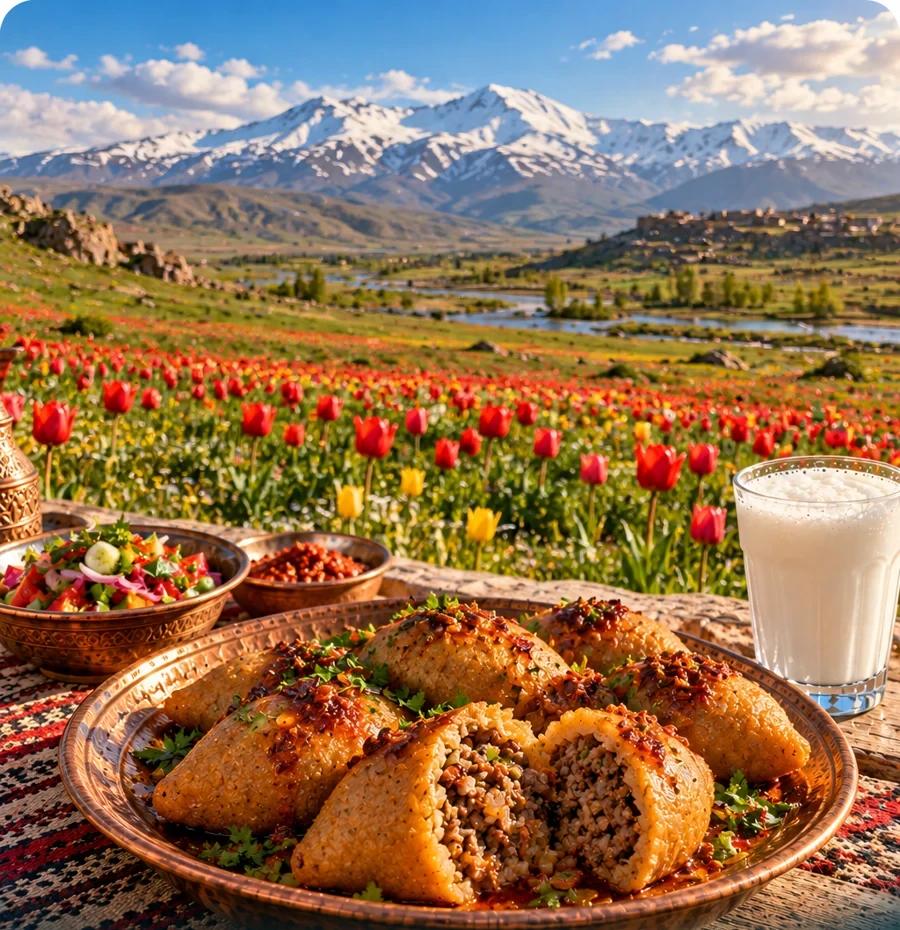
The Muş plain, cabbage dolma and bulgur köfte in spiced butter.
Explore the distinct textures of bulgur shells, cabbage leaves and slow-cooked wheat.
Stuffed bulgur and meat köfte
Balls of fine bulgur and hand-chopped meat filled with fatty mince and onion, boiled, then turned in butter with red pepper flakes.
Pickled cabbage with lamb
Çorti pickle cooked with bone-in lamb, bulgur, butter and tomato paste.
Cabbage stuffed with meat and rice
Cabbage leaves filled with diced meat and rice, then cooked slowly in a pot.
Meat and chickpea soup
Meat boiled until it comes away from the bone, cooked with chickpeas and other pulses.
Boiled meat with wheat
Boiled boneless meat combined with boiled wheat and served with sizzling fat poured over.
Dried cucumber peel meze
Dried cucumber peels fried with onion and pepper, served with a garlic yogurt sauce called işkene.
Bread soaked in molasses
Village bread soaked in molasses and topped with cream and hazelnuts.
Recipes from this city are coming soon.
A cream-colored kaşar made mostly from sheep’s milk with cow’s and goat’s milk, ripened for several months.
Guide not written yetFinely chopped white cabbage pickled with basil, pepper flakes, lemon and salt, without vinegar.
Guide not written yetLight-colored honey containing pollen from many of the region’s endemic plants.
Guide not written yetDried yogurt, used in local dishes such as cavbelek.
Guide not written yetThe provincial education directorate’s city resource describes rug and carpet weaving, feltwork, saddle making, knitting and other handcrafts. These practices bring household skill and materials into the account alongside monumental history. District differences matter here: a food linked to the city may also circulate through village kitchens, and a provincial craft list does not mean every household practises every craft.
Çorti, cabbage pickled without vinegar, is eaten with meals and also cooked with bulgur and lamb.
Muş köftesi is eaten every day and is also made to offer guests on special occasions.
A good way to begin exploring Muş is with the ground it stands on. The city was built on the north slopes of Kurtik Mountain, an important peak of the Haçreş Mountains. These mountains are an extension of the Southeast Taurus range. The city lies between the valleys where the Çat and Karni streams flow. No one knows when Muş Castle, in the city center, was built. The Grand Mosque was built on the slope at the castle’s foot. Seeing the castle and the mosque together makes it easier to understand how the town took shape against the mountainside.
The province’s history does not stop at the center. Malazgirt is remembered as the Turks’ entrance gate into Anatolia following the Battle of Malazgirt in 1071. Its castle is distinguished by two parallel ramparts surrounding the town. Near Varto, in the province’s northwest, Kayalıkaya Village is home to Kayalıdere, an Urartian settlement. Its castle dates from the reign of the Urartian king Sarduri II. The finds from its excavations are exhibited at the Anatolian Civilizations Museum in Ankara. The Murat Bridge dates from the Seljuk period, though its exact construction date is not known.


