


Bitlis büryan kebabı
Pit-cooked goat
Salted young goat hung in a tandır pit over a copper pot of water, sealed and cooked with heat and steam, served with fresh grapes.
Eastern Anatolia
The tandır is a good place to begin at the Bitlis table. For büryan kebabı, young goat salted with rock salt cooks with heat and steam inside a sealed tandır, above a copper pot of water. It then comes to the table with fresh grapes. The boneless meat and fat of büryan can become avşor çorbası, a soup seasoned with tomato and pepper paste and red pepper flakes and eaten in the morning. After the tandır, it is bulgur’s turn, and here bulgur takes many shapes. Bitlis içli köftesi hides a filling of kidney fat, onion and sour pomegranate. Ciğer taplaması turns lamb liver into small flat patties served hot with butter and red pepper flakes. In katıklı dolma, thin strips of squash wrap around minced meat and bulgur and are finished with garlic yogurt and chilli butter. The pantry holds polyfloral Bitlis honey from the high plateaus, sold as comb, chunk and strained honey. Alongside it are large-kernelled Adilcevaz walnuts and Hizan hazelnuts. That is why a journey that starts with büryan stretches all the way to the walnuts of Adilcevaz and the hazelnuts of Hizan.
Last updated:
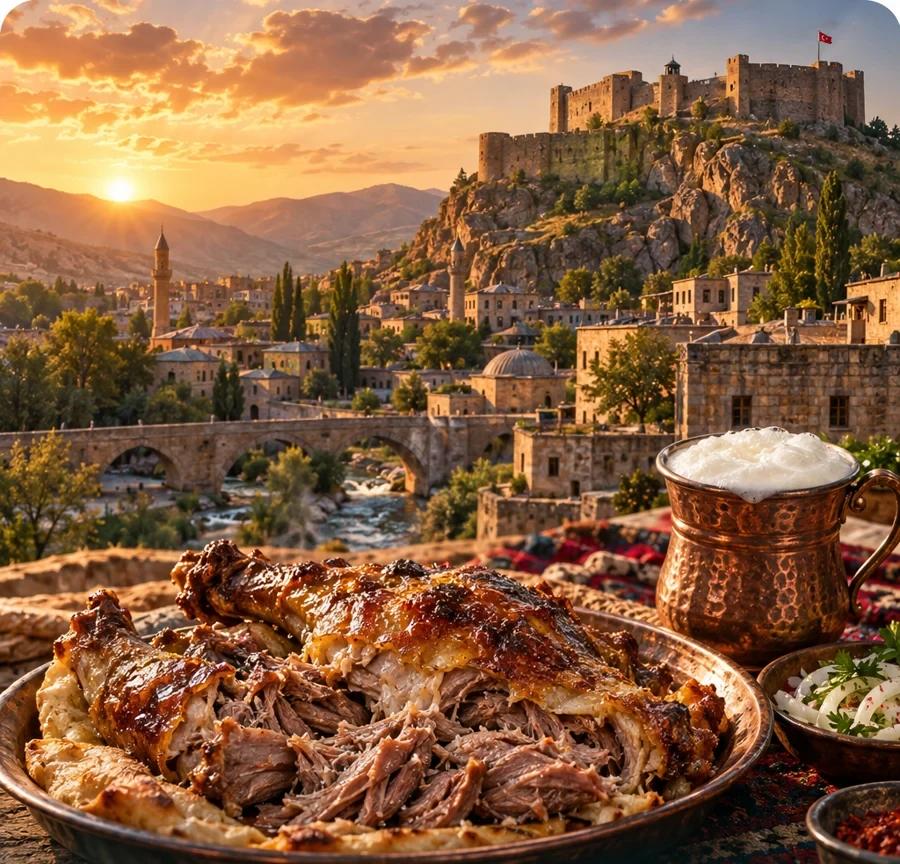
Stone houses, a deep valley and a tandır table.
Walnuts offer an ingredient-focused starting point for a province with substantial meat, grain and dairy traditions.
Pit-cooked goat
Salted young goat hung in a tandır pit over a copper pot of water, sealed and cooked with heat and steam, served with fresh grapes.
Stuffed bulgur dumplings
Lean beef and fine bulgur shaped by hand around a filling of kidney fat, onion and sour pomegranate, then boiled.
Squash rolls with yogurt
Thin strips of squash rolled around minced lamb and bulgur, simmered and served with garlic yogurt and chilli butter.
Büryan meat soup
Boneless büryan meat and its fat simmered with tomato and pepper paste and red pepper flakes; eaten in the morning.
Liver and bulgur patties
Small flat patties of lamb liver, bulgur, onion and semolina, boiled and served hot with butter and red pepper flakes.
Bulgur patties in sour cabbage
Flat bulgur, flour and semolina patties boiled with çorti, a brined cabbage, then topped with garlic broth and chilli butter; mostly a winter dish.
Sour cabbage and meat stew
Bone-in meat cooked with plenty of çorti, a brined cabbage made without vinegar, and pounded wheat; a winter dish.
Recipes from this city are coming soon.
Polyfloral honey from Bitlis’s high plateaus, sold as comb, chunk and strained honey.
Guide not written yetWalnuts with large kernels grown in Adilcevaz.
Guide not written yetHazelnuts grown in the Hizan district.
Guide not written yetSheep’s-milk cheese matured in tin or earthenware containers.
Guide not written yetThe tombstones at Ahlat preserve individual craft decisions as well as commemorative texts. Their signed work is a reminder that heritage is made by people with technical knowledge, rather than appearing as an anonymous backdrop. Within Bitlis, domestic stone architecture and museum collections offer another scale of cultural history. Household spaces, garden courtyards and objects of daily use sit alongside monumental remains.
Goat cooked in the tandır pit gives büryan and the avşor soup made from it.
Bulgur becomes içli köfte, liver taplama and çorti taplama.
Bitlis city center lies in a valley full of historic buildings. Its traditional houses were built from uniform dressed stone with flat roofs of compacted earth. Usually separated from the street by a high wall, they may look quiet from outside, but inside they open onto stone-paved courtyards and gardens full of fruit trees. The Grand Mosque, an example of Seljuk architecture, is among the city’s landmarks. The Şerefiye Complex, built by Şerefhan IV, brings together a mosque, a madrasa, an imaret and a tomb.
Ahlat, a separate district, lies on the shore of Lake Van and is known for its historic tombstones. These stones date from the 12th to the 15th centuries. Their front faces carry information about the deceased, epitaphs and verses of the Qur’an, while the back bears the name of the master who made the stone. These inscriptions are also a valuable source on the masons and craftsmen of the period. Ahlat’s lakeside Coastal Castle was built by the architect Sinan, commissioned by Suleiman the Magnificent.


