


Diyarbakır ciğer kebabı
Lamb liver kebab
Cubes of lamb liver and tail fat threaded on skewers, grilled and seasoned with salt, pepper flakes and herbs.
Southeastern Anatolia
You can step into Diyarbakır’s kitchen with a single skewer: ciğer şiş, where lamb liver and tail fat are cooked over the fire and seasoned with salt and pepper flakes. Next comes kaburga dolması, a dish that asks for patience. These lamb ribs are filled with diced lamb, rice and almonds and arrive browned in butter. In ayvalı kavurma, mutton fried with unpeeled quince is served on thin bread. Meat cooked with fruit like this carries the mark of the city’s old mansion kitchens. Home pots tell another part of the story, filled with wheat and lentils. Habenisk, a thick soup of pounded wheat, green lentils and chickpeas, is finished with a scattering of pepper flakes. For dessert there is burma kadayıfı, its thin strands wrapped around walnuts or pistachios and topped with syrup. If your curiosity reaches beyond the plate, look out for the oval Sürme watermelons and dark-grained Karacadağ rice that grow around the city. On a table that runs from mansion kitchens to home pots, the produce deserves as much attention as the dishes.
Last updated:
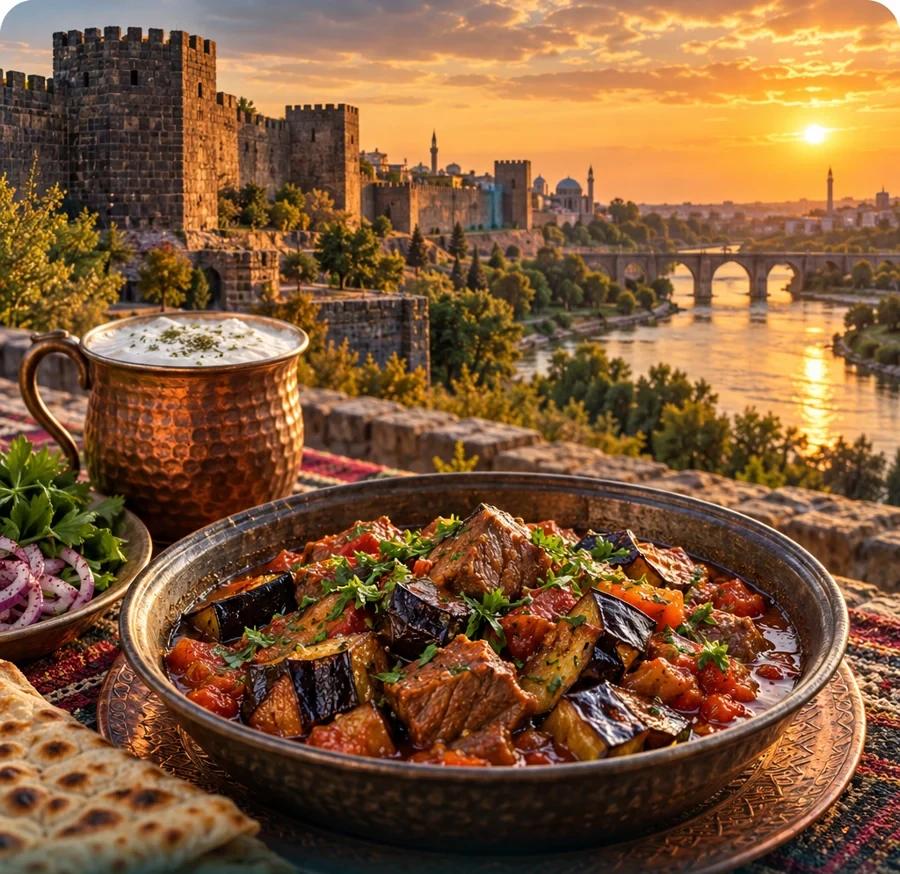
Basalt walls, the Hevsel Gardens and skewers of lamb liver.
Explore the contrast between quick-grilled liver and slowly prepared rice-and-meat dishes.
Lamb liver kebab
Cubes of lamb liver and tail fat threaded on skewers, grilled and seasoned with salt, pepper flakes and herbs.
Stuffed lamb ribs
Lamb ribs filled with diced lamb, rice and almonds, simmered for hours and finished with butter until golden.
Yogurt and wheat dish
Sheep’s yogurt thinned to ayran and cooked with pounded wheat, sometimes with wild mint or kenger, and usually eaten cold.
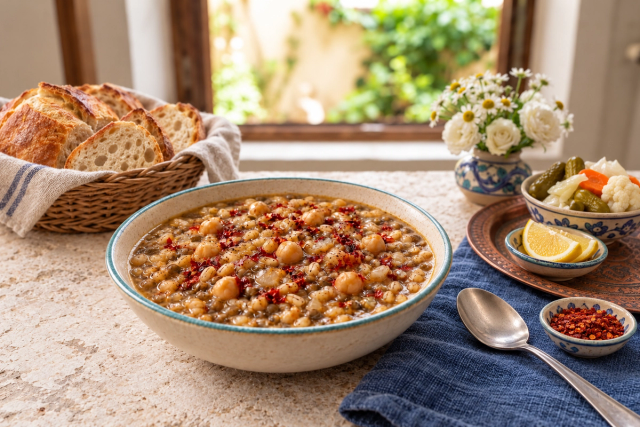
A thick, meatless Diyarbakır soup of hulled wheat, whole green lentils and chickpeas, finished with onions cooked in clarified butter and Turkish red pepper flakes.
Mutton with quince
Cubed mutton cooked in its own juices, then fried with unpeeled quince and served on thin bread.
Lentil and bulgur köfte
Köfte of ground lentils and fine bulgur with spices, green herbs and vegetables.
Layered tripe kebab
An offal kebab named after the many layers of the animal’s tripe.
Twisted walnut kadayıf
Thin strands of flour-and-water dough wrapped around walnuts or pistachios, baked and topped with syrup.
Oval watermelons of the Sürme variety, harvested from late July.
Guide not written yetRice from the Karacadağ area with darker plants and grains.
Guide not written yetA plaited cheese from Diyarbakır.
Guide not written yetPeppers grown in the Çermik district.
Guide not written yetThe relationship between city and garden offers a way to connect monumental heritage with everyday labour. Cultivation, exchange and urban life belong in the same account rather than being separated into a castle story and a food list. Diyarbakır’s mosques, churches and domestic spaces also preserve a plural cultural history. Present-day access and restoration conditions can change, so this introductory guide does not promise that particular buildings are open.
Meat with fruit, as in ayvalı kavurma, marks the old mansion cooking, while wheat and lentils fill home pots.
Large Sürme watermelons and dark-grained Karacadağ rice grow around the city.
Diyarbakır’s story begins with the ground beneath it. The city sits on the eastern side of a wide, gently sloping basalt plateau that reaches from Karacadağ toward the Tigris. The walls that enclose it were built from local basalt, limestone and brick, and the outer walls reached their present extent under Roman rule in the fourth century. Inscriptions from different periods let you follow the city’s changing rulers in the stone itself. Roman and Byzantine sources knew the city as Amida.
Between the walls and the river lie the Hevsel Gardens, a broad green link between the city and the Tigris that supplied the city with food. How vital that link was became clear in 1085. During a prolonged siege the gardens were destroyed, and the city, unable to withstand the hunger, surrendered to the Seljuks. In the northeast corner of the walled area, İçkale stands on the Amida Mound, where traces of the first settlement appear. Every power that ruled the city used it as a control center. South of the city, the Ten-Eyed Bridge takes its name from its ten arches.


