


Bingöl çobantaşı kavurması
Slow-cooked kid meat
Bone-in kid meat cooked only with water, salt and its own fat, eaten hot or cold.
Eastern Anatolia
A good way into the Bingöl table is to follow the yogurt: ayran, kurut and garlic yogurt find their way into breads, rice and soups. Even so, the first plate is a strikingly plain one. Çobantaşı kavurması brings bone-in kid meat together with nothing but water, salt and its own fat, and it is eaten hot or cold. Then come the dishes where dough meets dairy: sörin, a baked dough dish dressed with garlic yogurt and browned butter, and keldoş, where hand-shaped bread baked in wood embers meets garlicky kurut and a pour of hot butter. For something sweet there is burma kadayıfı, its strands wrapped around walnuts into rose shapes. The Sivan mulberry molasses that goes into it leads to the Sivan area of Genç, where white mulberry juice is boiled down over oak fires with no additives. The larder holds two more names: Bingöl balı, a polyfloral honey protected in the European Union as a designation of origin, and the large white Yedisu horoz beans that cook without breaking apart. Following that molasses from burma kadayıfı to the oak fires of Sivan makes a fine start to discovering Bingöl and its districts.
Last updated:
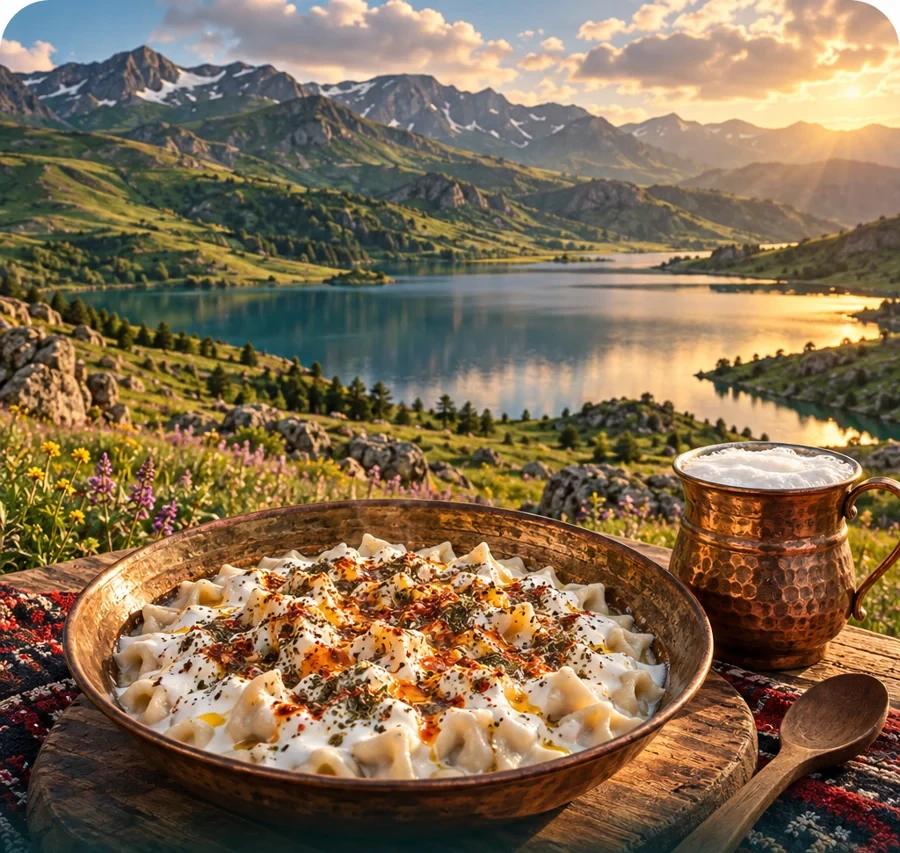
Mountain plateaus, lakes and a table rich in dairy.
Begin with honey, then explore how dough and cultured dairy are combined in substantial dishes.
Slow-cooked kid meat
Bone-in kid meat cooked only with water, salt and its own fat, eaten hot or cold.
Walnut kadayıf roses
Kadayıf strands rolled around walnuts into rose shapes, baked with clarified butter and Sivan mulberry molasses, then soaked in syrup.
Baked dough with garlic yogurt
Thin sheets of dough cut, stacked on a tray and baked, then dressed with garlic yogurt and browned butter.
Layered filled pastry
Thin layers of yeast dough filled with curd cheese, kavurma, parsley and potato and baked; made for holidays and weddings.
Ember bread with kurut
Hand-shaped bread baked in wood embers, broken up and dressed with garlicky kurut and hot butter.
Rice cooked in yogurt
Rice cooked with yogurt, eggs, a little flour and butter.
Wheat and ayran soup
Wheat boiled in ayran with a local wild mint.
Dried yogurt soup
A winter soup made with kurut, yogurt boiled and dried, known locally as şor.
Recipes from this city are coming soon.
Polyfloral honey from Bingöl’s mountain meadows.
Guide not written yetLarge white horoz beans from Yedisu that cook without breaking apart.
Guide not written yetWhite mulberry juice boiled down over oak fires in the Sivan area of Genç, with no additives.
Guide not written yetLarge, lobed red tomatoes grown from local seed in villages around the city.
Guide not written yetYogurt boiled and dried, used in soups and on keldoş.
Guide not written yetThe provincial culture directorate records Kartal, a dance whose movements evoke an eagle, within a repertoire accompanied by drum and zurna. Its account connects dance with gatherings such as weddings. Different origin stories circulate, so they should be understood as stories rather than verified historical events. Food and performance both involve knowledge learned through participation. This guide introduces selected practices without suggesting that every community or household follows one uniform tradition.
Ayran, kurut and garlic yogurt dress breads, rice and soups.
Upland honey, mulberry molasses and Yedisu beans come from the province’s valleys and plateaus.
A good way into Bingöl is through its natural setting. Located at a transition point in Eastern Anatolia, the province is marked by mountains, plateaus, plains, streams and lakes. At the Yüzen Islands, on a natural crater lake surrounded by mountains on three sides, the islands move independently, like rafts. Beside the Murat River, the Zağ Rock Shelter Rooms were carved directly into a steep rock and arranged on several storeys. They are thought to be of Urartian origin and to have been used later by Byzantine, Genoese and Persian civilisations.
In the provincial center, the İsfahan Bey Mosque in the Aşağı Bazaar was built of cut stone by İsfahan Bey in the early 16th century, during the Akkoyunlu period. Repaired many times because of the earthquakes that have affected Bingöl over the years, it is the only historical building in the city center. The Akkoyunlu legacy reaches beyond the center. In the district of Kiğı, the Balaban Bey Mosque also dates back to the Akkoyunlu period; built in the early 15th century, it holds the tomb of the Akkoyunlu bey Pir Ali Bey.


