


Malatya kâğıt kebabı
Lamb baked in paper
Lamb rib, shoulder and neck wrapped in greased paper with tail fat and rock salt, sealed in a copper pot and cooked slowly in a wood-fired stone oven, served hot.
Eastern Anatolia
Apricots may be the first thing you link with Malatya, but here the table opens with a kebab that will not be hurried. For kâğıt kebabı, lamb rib, shoulder and neck are wrapped in paper with tail fat and rock salt and cooked slowly in a copper pot inside a wood-fired stone oven. Analı kızlı köfte brings two sizes together: large stuffed bulgur meatballs and tiny plain ones side by side in a chickpea broth. Akçadağ kömbesi, filled with walnuts and minced meat, is usually eaten in winter and at large family gatherings. The apricot, grown here mainly for drying, reaches the kitchen even through its kernel: each crisp butter Malatya kurabiyesi, made for special occasions, carries a whole kernel on top. Köpük pestili, made from white grape juice and dried in the sun, comes out light and crisp. Add thin-shelled Hekimhan walnuts, and a route takes shape that leads from the kebab on to Akçadağ for its kömbe and to Hekimhan for its walnuts.
Last updated:
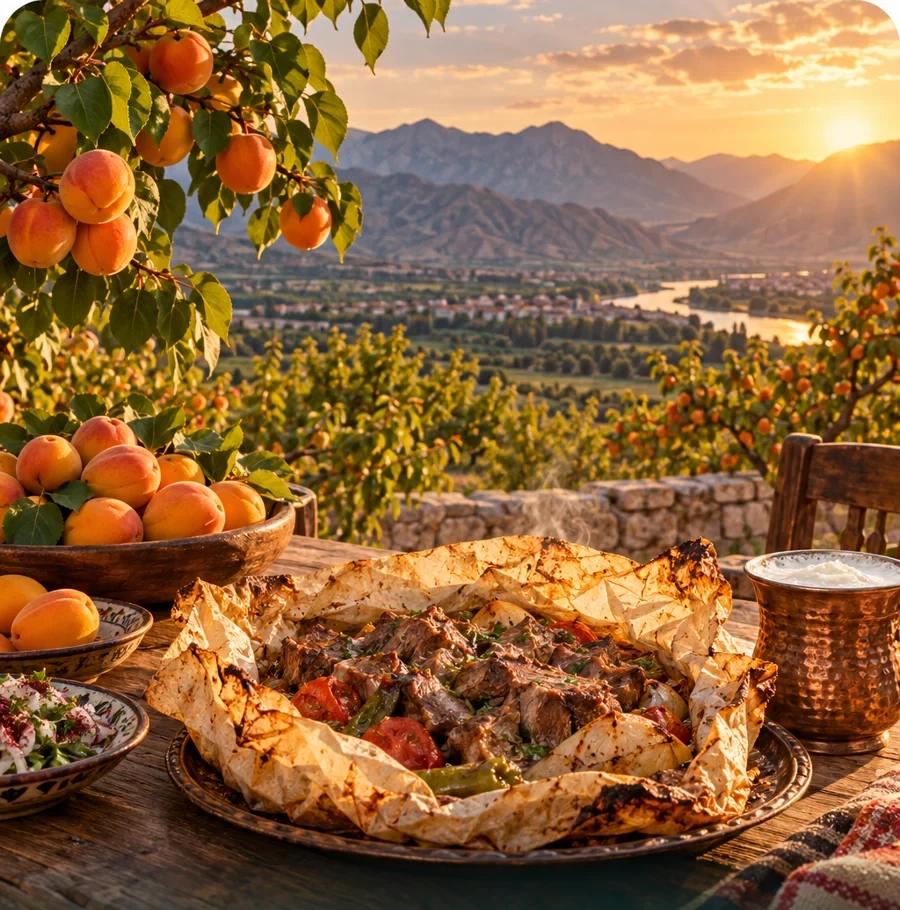
Apricots drying in the sun beside a table of meatballs.
Apricots are an inviting first taste. Continue into the breads, köfte and slow-cooked meat dishes that give Malatya’s cooking its breadth.
Lamb baked in paper
Lamb rib, shoulder and neck wrapped in greased paper with tail fat and rock salt, sealed in a copper pot and cooked slowly in a wood-fired stone oven, served hot.
Stuffed and tiny meatballs in broth
Large bulgur meatballs stuffed with spiced minced meat and tiny plain ones, boiled together in a chickpea broth with tomato and pepper paste, served hot.
Meat and walnut pastry
A pastry from Akçadağ filled with walnuts and minced meat and baked over a wood fire, usually eaten in winter and at large family gatherings.
Apricot-kernel butter biscuit
Crisp butter biscuits made with wheat flour and flour from sun-dried apricot kernels, each topped with a whole kernel, made for special occasions.
Whipped grape fruit leather
White grape juice cooked with sugar and wheat flour, whipped into a lasting foam, then spread on cloth and sun-dried into light, crisp sheets.
Recipes from this city are coming soon.
Apricots grown mainly for drying.
Guide not written yetSweet-tasting kernels from local apricot varieties.
Guide not written yetA large, heart-shaped sweet cherry that ripens dark red to almost black, picked around mid-June.
Guide not written yetThin-shelled walnuts from Hekimhan with a high share of kernel.
Guide not written yetA dark, almost purple grape from Arapgir with large seeds and a high sugar content.
Guide not written yetPurple basil from Arapgir, used dried and in a summer sherbet.
Guide not written yetA fruit leather made from apricots that are pitted, cooked and mashed.
Guide not written yetThe provincial culture directorate describes traditional homes with kitchens, shelves for vessels and adjoining food stores. Grains, dried produce, pickles and preserves belong to this account of household provision. It is a record of traditions, not a claim that every present-day home is arranged in the same way. Its account also connects kömbe and other dishes with welcoming visitors, celebrations and sharing food with neighbours. These social settings make a useful companion to a list of ingredients: the occasion matters as well as the dish.
Malatya’s apricots are grown largely for drying, and flour from their kernels goes into the local butter biscuits.
For kâğıt kebabı, lamb wrapped in paper with tail fat cooks for hours in a copper pot inside a wood-fired stone oven.
Malatya lies in the west of the Eastern Anatolia Region, at a point where roads running east-west and north-south meet. Just how far back settlement here reaches can be seen at Arslantepe Mound, not far from the city center. Rising from the fertile Malatya plain near the Euphrates, the mound shows occupation from at least the 6th millennium BCE. The most remarkable part of the site is its Late Chalcolithic palace complex, which belongs to a time when Arslantepe was a center of governance in the region. The site illustrates a sophisticated bureaucratic system that predates writing.
Later centuries come into view in Battalgazi, the district known as Old Malatya. Its Ulu Mosque was built in the 13th century, during the time of the Seljuk ruler Alaaddin Keykubat. The 17th-century Silahtar Mustafa Pasha Caravanserai, set on the roads leading east, reflects the commercial density of the city and served a military function as well as a commercial one. The Roman walls that once protected the city of Melitene now stand in ruins.


