


Şorbik
Beef, chickpea and milk soup
Beef cubes cooked in their own juices, turned in butter with onion and chickpeas, simmered and finished with warm milk; served hot, often at weddings.
Eastern Anatolia
In Tunceli’s kitchen, many dishes rest on four foundations: wheat, lentils, butter and ayran. Mahluta, a soup of lentils and coarsely ground wheat, arrives with hot melted butter poured over the top. Şorbik brings together beef cubes, chickpeas and onion, finished with warm milk. It is served hot and made most often at weddings. Patila, cooked on a sac griddle, holds minced meat and onion fried in butter between two thin sheets of dough. In zerefet, crumbled dough pounded with garlicky ayran has a hollow at its center filled with melted butter. Plants from the slopes find their way to the table as well. Fresh kenger, paired with plenty of onion and eggs, comes from there, as does single-clove mountain garlic harvested in August. If you want to follow the table out into the districts, look for Çemişgezek’s seedless white Ulukale mulberry, mostly sold sun-dried, and for Tunceli honey, promoted at Pülümür’s honey festival.
Last updated:
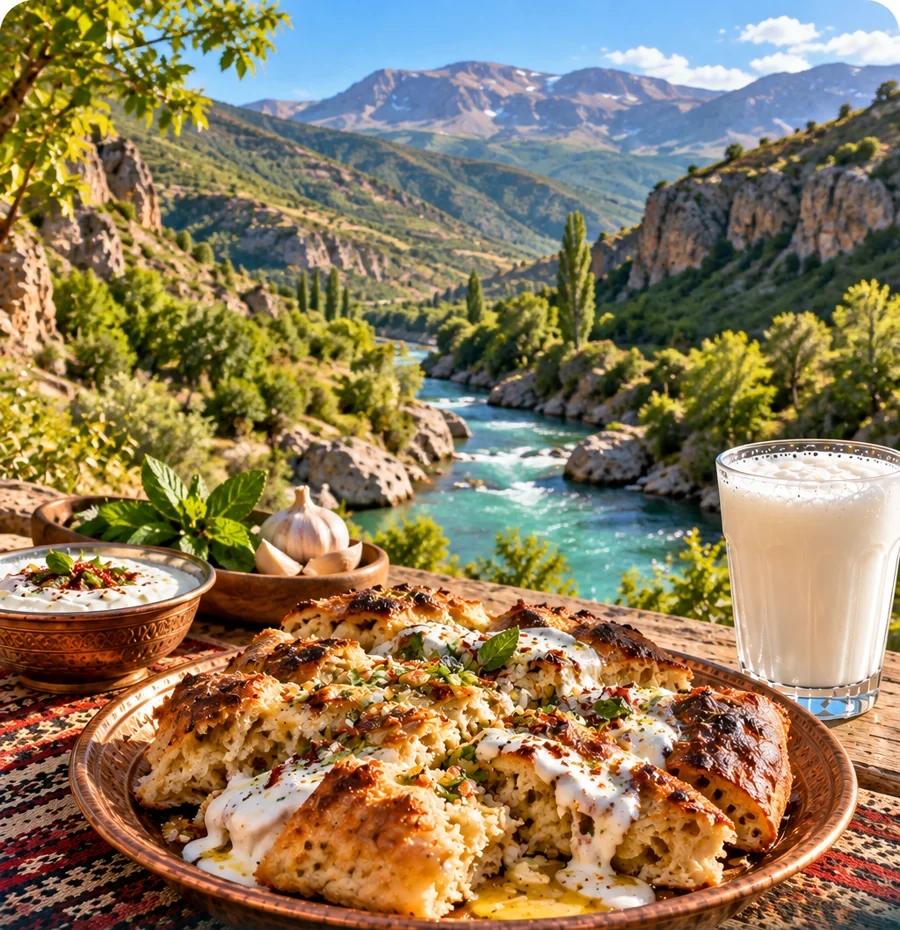
The Munzur river between steep mountain slopes.
Explore preserved fruit, grains and filled vegetables alongside the province’s cultural landscape.
Beef, chickpea and milk soup
Beef cubes cooked in their own juices, turned in butter with onion and chickpeas, simmered and finished with warm milk; served hot, often at weddings.
Lentil and cracked wheat soup
Soup of lentils and coarsely ground wheat, served with hot melted butter.
Lentil and bulgur köfte
Bulgur mixed with boiled lentils and flavored with butter and dried basil.
Stuffed dried peppers and eggplants
Dried peppers and eggplants boiled and filled with bulgur, minced meat, butter, tomato paste and spices.
Meat-filled griddle pastry
Two thin sheets of dough sealed around minced meat and onion fried in butter, cooked on a sac griddle and brushed with butter.
Pounded bread with garlic ayran
A baked dough of flour, salt and water, broken up and pounded with garlicky ayran, then served with melted butter in a hollow at the center.
Ayran soup with chickpeas
Ayran cooked with flour, salt and egg yolk, with soaked chickpeas added once it boils.
Sautéed wild kenger
Fresh kenger boiled and sautéed with plenty of onion, finished with eggs.
Recipes from this city are coming soon.
Single-clove mountain garlic (Allium tuncelianum) that flowers and sets seed; harvested in August.
Guide not written yetSeedless white mulberry, mostly sold sun-dried.
Guide not written yetCheese made in Çemişgezek, Hozat and Pertek from the milk of local herds.
Guide not written yetHoney from Pülümür and Ovacık, promoted at Pülümür’s yearly honey festival.
Guide not written yetThe museum’s belief section includes interpretation of Alevism and ritual life. This is an important cultural context, not a claim that all residents share one identity or practice. Aşure is described in the food sources as a dish of sharing. Fruit preservation and grain preparation add household work to the account, while district and family variations remain important.
Wheat, lentils, butter and ayran run through dishes such as mahluta, hazırlop köftesi and ayranlı aş.
Mountain garlic and kenger from the slopes reach the kitchen.
In Tunceli, water shapes how the past can be seen today. South of Çemişgezek district, the Pulur (Sakyol) Tumulus now lies beneath the waters of the Keban Dam Lake. Excavations there revealed a cultural layer from the late Neolithic and early Chalcolithic periods, and among the finds were temples with hearthstones engraved with human faces. The same dam has given Pertek Castle, built in the ninth century, the look of an island. Sungur Bey Mosque, which stood beside the Murat River at the foot of the castle, was moved to the center of Pertek before the dam was built; each stone was numbered and the mosque was rebuilt to the same specifications.
Belief is part of this landscape too. In the city center, Gole Çeto, where the Munzur and Pülümür streams meet, is regarded as a holy site by Alevis, as is Ana Fatma in the Munzur Valley. In Mazgirt, Pertek and Pülümür, ram-shaped tombstones carry Turkmen traditions of the Akkoyunlu period to the present. Their carvings describe the person buried below: a sword or horse for bravery, a pitcher and tray for generosity, and the Zulfiqar for an Alevi.


