


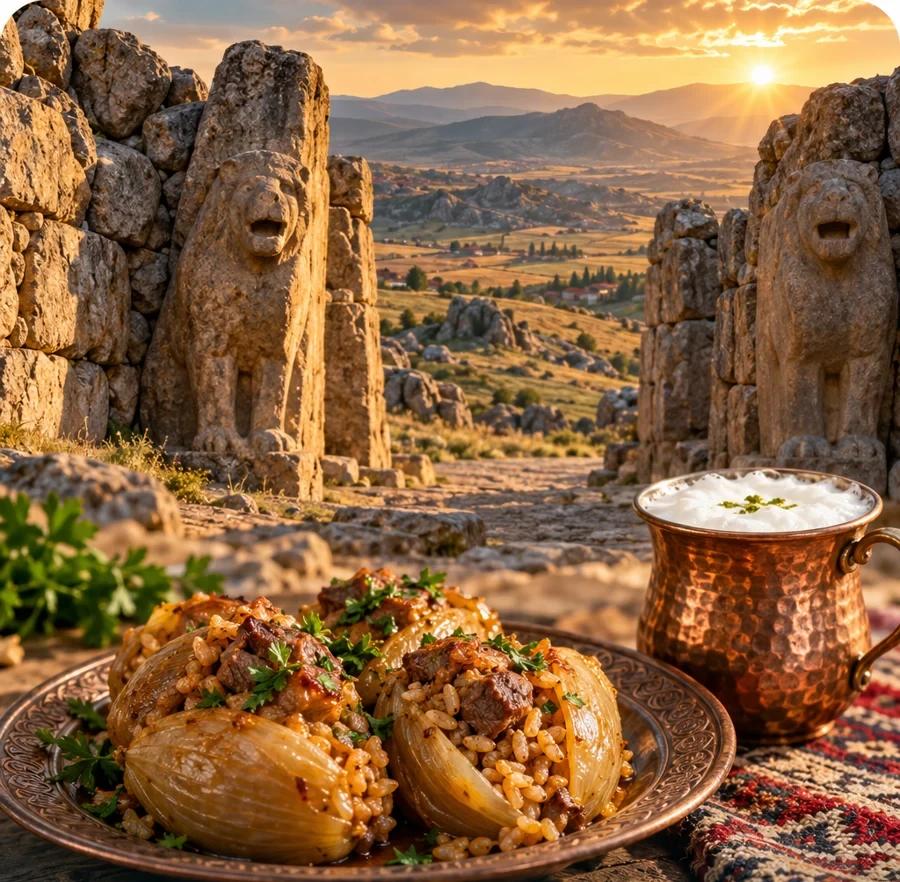
İskilip dolması
Rice and beef cooked in copper
Rice in a cloth bag cooked over beef and onions in a sealed copper pot, made for weddings by cooks called dolmacı.
Black Sea Region
Some of Çorum’s dishes ask for patience, others for a practised hand. İskilip dolması is known for rice in a cloth bag cooked for hours over beef and onions in a copper pot sealed with dough. At weddings, that job falls to cooks known as dolmacı. Çorum kuru mantısı brings minced-meat dumplings, folded into six to eight points, together with a tomato-paste sauce and garlic yogurt. Keşkek, hulled wheat and mutton cooked slowly in an earthenware pot, is a dish of village weddings and Ramadan. At weddings, the table is set with the Çorum five: düğün çorbası, yahni, pilav, su böreği and baklava. This baklava is made from thin walnut-filled strips of dough twisted into rose shapes. Alongside the table come two local products. One is Çorum leblebisi, chickpeas roasted several times over a wood fire. The other is Kargı tulum peyniri, made from the milk of animals grazed in the Kargı highlands and kept in small skins. Get to know Çorum by following that five-dish wedding table.
Last updated:
Wood-fired leblebi ovens, rice fields and walnut groves.
Start with leblebi, then explore rice, meat and cheese through their district associations.
Rice and beef cooked in copper
Rice in a cloth bag cooked over beef and onions in a sealed copper pot, made for weddings by cooks called dolmacı.
Fried meat dumplings
Dumplings filled with minced meat and folded into six to eight points, fried in copper trays, cooked in tomato-paste sauce and served with garlic yogurt.
Lamb from the tandır
Lamb cooked in a brick tandır over dried oak and served on thin buttered pide with salad.
Whole lamb on a pole
A whole lamb threaded onto a long pole and turned slowly beside an open fire.
Wheat and mutton porridge
Hulled wheat and mutton cooked slowly in an earthenware pot, a dish of village weddings and Ramadan.
Wild knotweed greens
Wild madımak greens cooked in clarified butter with onion, bulgur and a little pastırma.
Yogurt wedding soup
A soup of strained yogurt, milk, eggs, flour and chicken stock, served at weddings.
Rose-shaped walnut baklava
Thin dough strips filled with walnuts and twisted into rose shapes, dried, baked with butter and soaked in syrup.
Recipes from this city are coming soon.
Chickpeas roasted several times over a wood fire, sold plain or flavored.
Guide not written yetCheese from the milk of animals grazed in the Kargı highlands, kept in small skins.
Guide not written yetThin-shelled walnuts with full, white kernels from Oğuzlar.
Guide not written yetRice grown in the Osmancık and Kargı districts.
Guide not written yetStrawberries grown in the İskilip district.
Guide not written yetCarved stone, clay tablets and museum interpretation offer different ways to encounter the region’s past. The surviving monuments preserve evidence of institutions and skilled work rather than a complete picture of everyday ancient life. Today’s food associations are another layer. District names such as İskilip, Kargı and Osmancık help keep the provincial story specific instead of reducing Çorum to a single snack.
Weddings serve düğün çorbası, yahni, pilav, su böreği and baklava, known together as the Çorum five.
İskilip dolması cooks for hours in tinned copper pots over oak or fruitwood.
One of Çorum’s important ancient cities lies not in the provincial center but in the district of Boğazkale. Hattusha was the capital of the Hittite Empire. It was built on a slope at the southern end of the Budaközü Plain, and the Kızlarkayası creek divides it in two: a lower city to the north and an upper city to the south. In the lower city stands the Great Temple, the ruin of a Hittite temple from the 13th century BCE.
Northeast of the capital is Yazılıkaya, an open-air sanctuary formed by natural chambers in the bedrock. Its walls carry reliefs of gods and goddesses alongside figures of the Great King Tuthaliya IV. Another major site in the province, Alacahöyük, was an important center of cult and art in the Old Bronze Age and the Hittite period. Its Old Bronze Age dynasty tombs have contributed greatly to understanding the indigenous Hatti civilization, a leading source of the cultures that gave rise to Hittite culture.


