


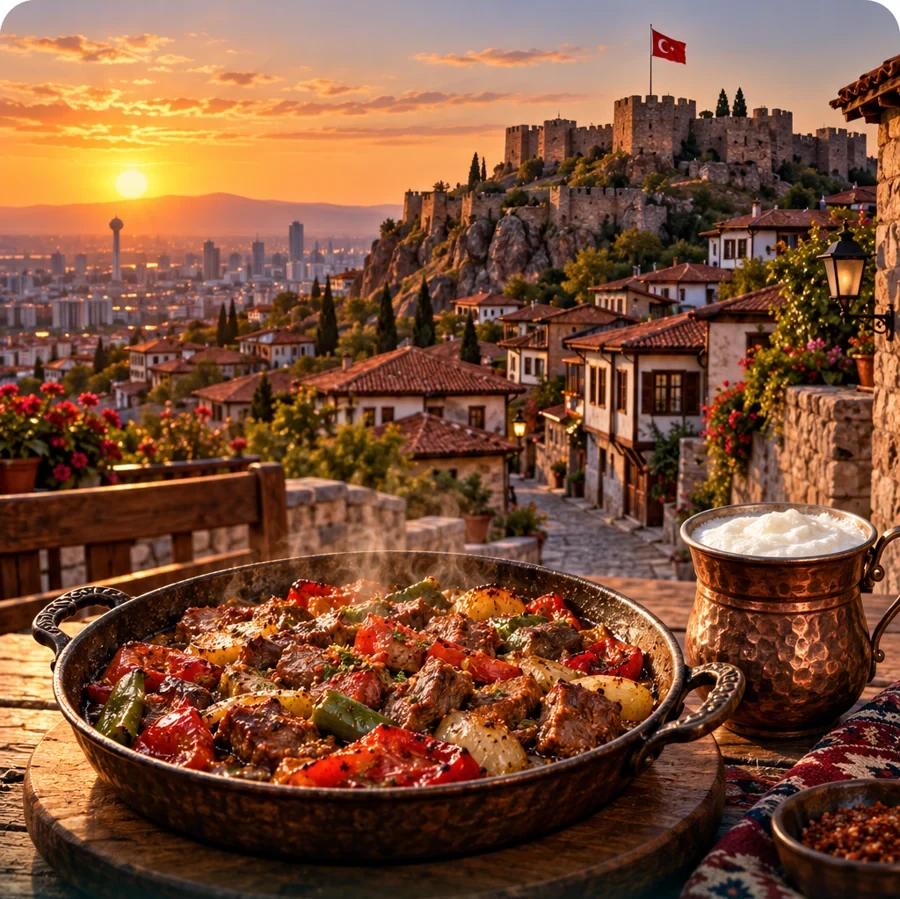
Ankara tava
Stone-oven lamb on rice
Forearm and rib meat of local sheep and lambs, cooked in a stone oven over oak, hornbeam or beech wood and served on rice in a tinned copper dish.
Central Anatolia
A tinned copper dish is a good place to begin getting to know Ankara’s table. Ankara tava, made with the forearm and rib meat of local sheep and lambs, comes out of a stone oven fired with oak, hornbeam or beech wood and is served in that very dish, over rice. Kazan kavurması from Kahramankazan takes a different path. No spices are used, and the beef cooks in its own juices with onion, suet and salt; it stands out for its simplicity. In Beypazarı, dolma filled with rice and minced lamb and rolled as thin as a little finger in local vine leaves arrives with its cooking liquid. Two familiar names wait on the sweet side: höşmerim, made with milk, kaymak and wholemeal flour, and cevizli tatlı sucuk, strings of walnuts coated layer upon layer in a grape-must mixture called köfterlik. Follow your curiosity a little further and you reach the surrounding districts. Kalecik karası grapes, Çubuk’s deep red, very juicy sour cherries and Ayaş tomatoes show that the capital’s cooking reaches well beyond the city center.
Last updated:
Steppe vineyards, sesame simit and stone-oven tava.
Explore the difference between a street-food ring, a celebratory oven dish and a biscuit baked to keep its crispness.
Stone-oven lamb on rice
Forearm and rib meat of local sheep and lambs, cooked in a stone oven over oak, hornbeam or beech wood and served on rice in a tinned copper dish.
Crisp sesame bread ring
A sesame-covered bread ring, smaller and crisper than simit elsewhere in Türkiye.
Slow-cooked beef kavurma
Beef, onion, fat and salt, with no spices, cooked slowly in its own juices; a speciality of Kahramankazan.
Small stuffed vine leaves
Rice, minced lamb, onions and herbs rolled finger-thin in local vine leaves and served in their cooking liquid.
Twice-baked butter biscuit
A dry, twice-baked butter biscuit eaten with tea.
Kaymak and flour sweet
A batter of milk, wholemeal flour and kaymak cooked in butter and served with syrup, molasses or honey.
Walnuts coated in grape must
Strings of walnuts dipped again and again in a thickened grape-must mixture (köfterlik) and dried layer by layer.
Carrot Turkish delight
A lokum made from carrots grown in Beypazarı, less sweet than ordinary Turkish delight.
Recipes from this city are coming soon.
Tomatoes grown in the Ayaş district.
Guide not written yetDeep red, very juicy sour cherries from Çubuk.
Guide not written yetA dark-skinned red wine grape named after Kalecik.
Guide not written yetAnkara goat meat coated in garlic and fenugreek and dried in the sun.
Guide not written yetCarrots grown in Beypazarı, made into juice, jam and lokum.
Guide not written yetAnkara tava offers a connection between cooking and celebration. A provincial cultural account published by the Ministry describes meat and rice prepared in copper vessels and stone ovens for ceremonial occasions. It also records changes in the equipment and settings used to make it. That account is a dated cultural record, not a claim about every restaurant today. It shows why a dish can matter through the occasions and skills surrounding it, as well as its ingredients.
Beypazarı brings kurusu, höşmerim, dolma and carrot lokum to the capital’s table.
Kalecik karası grapes, Çubuk sour cherries and Ayaş tomatoes grow in the surrounding districts.
Ankara Castle is a good place to begin exploring Ankara’s past. Originally built as a garrison, the citadel has hosted several civilizations over the course of its history. The city’s Roman past is never far away. The Temple of Augustus, named after the emperor, was transformed into a church in the early Christian era, and today the Hacı Bayram Veli Mosque leans against its walls. At the Roman Baths, the ruins form a mound, with the Roman level at the top and the remains of a Phrygian-period settlement beneath it.
The building that now houses the Independence War Museum served as the First Turkish Grand National Assembly in the founding years of the Republic. The province itself stretches far beyond the city. In a forested valley to the north, the thermal waters of Kızılcahamam are known to have been used since the Roman period. To the southeast, in Şereflikoçhisar district, Lake Tuz spreads out as a vast, flat white surface. The lake produces a large share of Türkiye’s salt and is also an important habitat for many bird species, most notably flamingos.


