


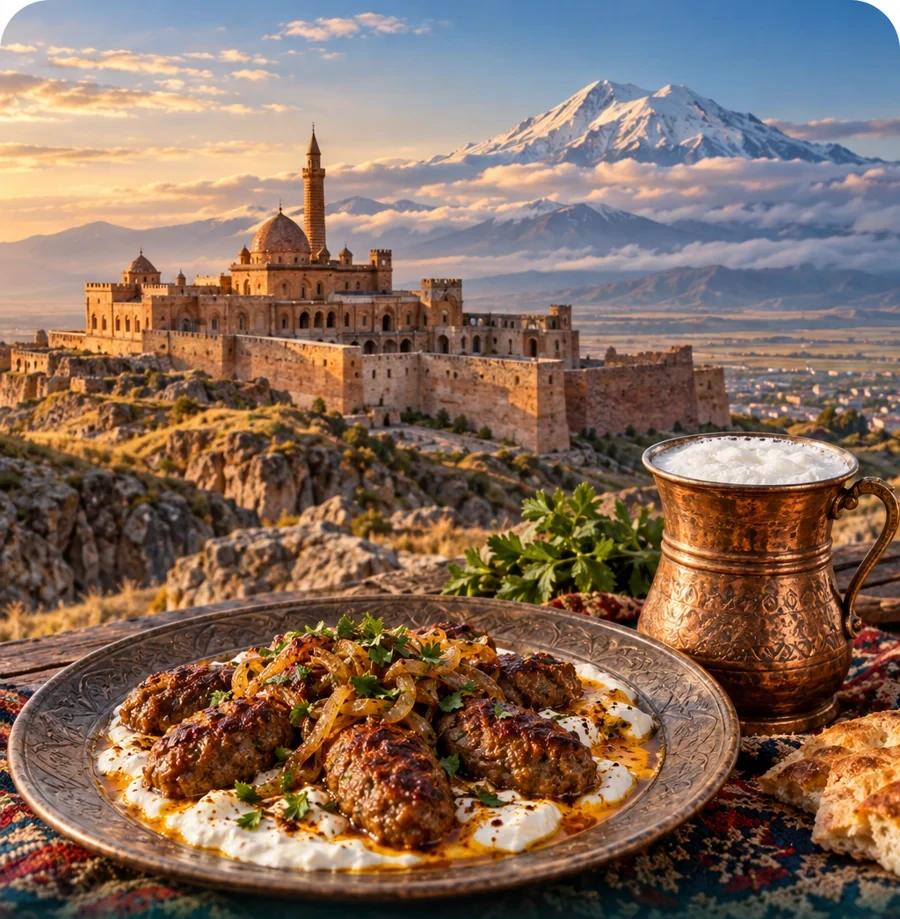
Doğubayazıt abdigör köftesi
Pounded beef köfte
Lean beef pounded on a stone until smooth, whipped with a little onion, egg and spices and served on rice.
Eastern Anatolia
Sit down to eat in Ağrı and you soon notice how often butter takes the lead. Still, the first stop is Doğubayazıt’s abdigör köftesi: lean beef pounded on a stone, with a little onion, egg and spices, served on top of rice. Haşıl is thick fine cracked wheat with a pool of butter in the middle and garlic yogurt around it, and the dish is shared from a single bowl. Keledoş brings lamb, chickpeas and wheat together with foraged greens, finished with melted butter and kurut, a dried strained yogurt. Ağrı ketesi, cooked in butter, is also called çiriş ketesi, after çiriş, a wild herb that grows in spring and is also known as mountain leek. To finish, Doğubayazıt aşure is made without sugar and sweetened only with Ağrı’s pale geven honey. At a table that opens with abdigör and closes with honey-sweetened aşure, Ağrı’s tulum cheese is there to call you on to the next tasting.
Last updated:
High pastures, beehives and butter-rich highland cooking.
Explore the texture of pounded meat, the work of beekeepers and the breads that accompany an upland table.
Pounded beef köfte
Lean beef pounded on a stone until smooth, whipped with a little onion, egg and spices and served on rice.
Leaf-cut döner
Döner made from the meat of animals raised on Ağrı’s wide highland pastures.
Cracked wheat with butter
Fine cracked wheat cooked thick, with a pool of butter in the middle and garlic yogurt around it, eaten from one dish.
Wheat, lamb and chickpea stew
Lamb, chickpeas and wheat cooked with foraged greens and served with melted butter and kurut.
Griddle-cooked lamb
Kid or lamb cooked in butter on an iron sac over a wood fire and served with garlic yogurt.
Butter-cooked bread
Bread dough, used before it turns sour, rolled into small pieces and cooked in butter; also called çiriş ketesi.
Honey-sweetened aşure
Aşure sweetened only with Ağrı’s geven honey, with no sugar.
Recipes from this city are coming soon.
A pale honey from Ağrı’s highlands.
Guide not written yetTulum cheese made in Ağrı.
Guide not written yetDried strained yogurt, crumbled over keledoş.
Guide not written yetA wild spring herb, also called mountain leek, used in local dishes.
Guide not written yetWool links livestock keeping with another household skill: kilim weaving. The provincial culture directorate describes flat-woven textiles with geometric, animal and plant motifs, using wool as a principal material. Patterns and techniques make these objects worth considering in their own right. A food journey can therefore include both the finished meal and the materials of daily life. The guide’s bread, dairy and honey connections are part of a wider provincial setting, rather than a fixed menu served by every household.
Livestock and bees raised on the highlands give the table its meat, butter and honey.
Foraged plants such as çiriş go into kete, and local greens go into keledoş.
One of Ağrı province’s notable historic buildings is not in the provincial center but in the district of Doğubayazıt, the closest settlement to Mount Ağrı. İshak Paşa Palace stands on a hill overlooking Doğubayazıt. Near the Iranian frontier on the Silk Route, the palace occupies a strategic position. Its architecture brings together Anatolian, Iranian and North Mesopotamian traditions. For about two centuries, the palace served as the administrative center of the region.
East of Doğubayazıt, Doğubayazıt Castle is also known as the Urartian Castle. Its builder is unknown, but its position on the cliffs is striking, and Urartian rock tombs lie inside it. The castle was also used in Seljuk and Ottoman times. Beside it stands the Old Beyazid Mosque, built after the region joined the Ottoman lands following the Battle of Çaldıran in 1514. Traces of Urartu continue around Patnos, too: Girik Tepe, just outside the town, was established during the reigns of King Menua and his son Argişti I.


