


Iğdır bozbaş yemeği
Lamb and chickpea stew
Bone-in meat simmered with onion, tomato paste, lepe chickpeas, turmeric and potatoes, served in a metal mug with lavash torn into the broth.
Eastern Anatolia
In Iğdır, what ties several dishes together is the yellow of sarıkök, or turmeric. In bozbaş, bone-in meat cooks with lepe chickpeas, sarıkök and potatoes; it arrives in a metal mug called a maşrapa, with lavash torn into the broth. Taş köfte is a köfte of meat pounded with a wooden mallet and brought together with lepe, rice and sarıkök, holding a sour plum known as alça inside. Lepeli ekşili pilav, rice with meat colored with turmeric, comes to the table mainly during Ramadan, holidays and special days. At the sweet end waits a surprising jam: patlıcan reçeli, made from small local eggplants called kara badımcan, boiled in syrup with lemon. Fruit and flowers belong to this table too. Iğdır apricots, including the oval Şalak variety, are picked from the last week of June, while red roses are gathered in May and turned into jam. Once you have followed the yellow thread of sarıkök, keep getting to know Iğdır through its May rose jam and its apricots from the end of June.
Last updated:
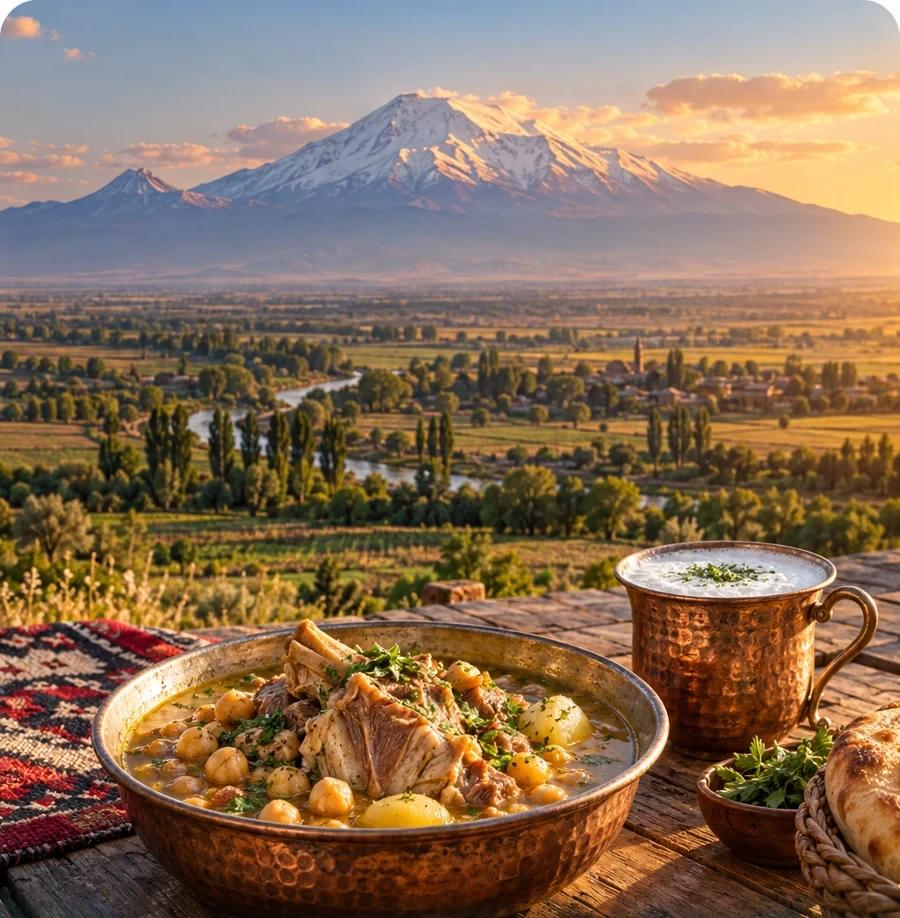
The Aras plain, apricot orchards and Mount Ağrı on the horizon.
A lamb-and-chickpea stew offers a starting point, followed by fruit and grain preparations.
Lamb and chickpea stew
Bone-in meat simmered with onion, tomato paste, lepe chickpeas, turmeric and potatoes, served in a metal mug with lavash torn into the broth.
Plum-filled meatballs
Meat pounded with a wooden mallet, kneaded with lepe, parsley, rice and turmeric, filled with a sour plum and simmered with potatoes.
Mung bean and noodle soup
Mung beans, evelik greens, bulgur, rice, sour plum and noodles cooked together, mostly in winter.
Turmeric rice with meat
Rice with meat, colored with turmeric, made mainly during Ramadan, holidays and special days.
Stuffed bağa leaves
Boiled bağa leaves wrapped around rice cooked with tomato, pepper paste, onion, garlic, parsley and spices, eaten with lemon.
Oblong meatballs
Meat mixed with finely chopped potato, onion and spices and shaped into oblong meatballs.
Flour and butter soup
Flour, fat and water cooked to a soup-like consistency and served with melted butter on top.
Eggplant jam
Small local eggplants soaked in lime water, peeled and boiled in syrup with lemon.
Recipes from this city are coming soon.
Apricots including the oval Şalak, picked from the last week of June.
Guide not written yetA white grape grown mainly in the Aralık district, especially around Kadıkışlak.
Guide not written yetRed roses picked in May and made into jam.
Guide not written yetTurmeric, used in bozbaş, taş köfte and pilaf.
Guide not written yetWild evelik greens, boiled for omaç aşı.
Guide not written yetThe provincial culture directorate describes instruments including nağara, garmon, clarinet and tütek in local performance. Its account connects parts of the repertoire with Azerbaijani and wider Caucasian musical traditions. Music makes exchange audible. The use of shared instruments and forms is more informative than a claim that cultural traditions follow provincial borders exactly. The guide does not adopt speculative instrument-origin stories from the source.
Sarıkök colors bozbaş, taş köfte and the festive lepeli pilaf.
Apricots, white grapes and red roses from the Aras plain go into jams, alongside one made from eggplant.
Two great features stand out in Iğdır’s geography: the Aras River and Mount Ağrı, also known as Ararat. The mountain rises on the border between the provinces of Ağrı and Iğdır. Where the Aras forms the border between Türkiye and Armenia, Karakale stands on steep cliffs. The Seljuks built it in the late 12th century. Its position gave it special strategic importance, at a point where the river could be crossed and on the road leading to the Iğdır plain.
The plain’s past can also be traced through its old cemeteries. The ram-headed gravestones found across the Iğdır plain are the last remains of the Kara Koyunlu period. They were erected on the graves of those who were brave and heroic, and of those who died young. The Harmandöven Ejder Caravanserai was built in the 13th century, during the Seljuk period, by Şerafettin Ejder Bey, Amir of the Surmari. It stands on the Batumi–Tabriz caravan route, one of the side roads of the Silk Road. At the Ahura Ruins, Urartian remains are found alongside traces of the Persian, Roman and Eastern Roman periods.

