


Sinop mantısı
Dumplings with walnuts and yogurt
Ear-shaped dumplings of thin dough filled with minced beef, served half with walnuts and half with garlic yogurt.
Black Sea Region
Getting to know Sinop can begin with a single plate. Sinop mantısı, ear-shaped dumplings filled with minced beef, arrives with one half covered in walnuts and the other in garlic yogurt. Once you have tried that divided plate, it is time to see what Sinop does with Black Sea anchovies. In içli tava, the hamsi meet onion, parsley, black raisins and pine nuts and come out of the oven together. Nokul, the sweet of festive tables, comes rolled around a filling of walnuts and raisins or minced meat, and in the morning it is eaten alongside katlama and a glass of tea. Travel on to Boyabat and the fire changes. For sırık kebabı, a whole lamb is threaded onto a long pole cut from resin-free wood and turned before a pine-wood fire until it is cooked. The pantry holds Sinop’s own products as well: Sinop chestnuts, eaten fresh in season, and chestnut honey produced right here in Sinop. Curiosity that starts with the two halves of a mantı plate carries you on from anchovies to nokul, and from there all the way to the pole in Boyabat.
Last updated:
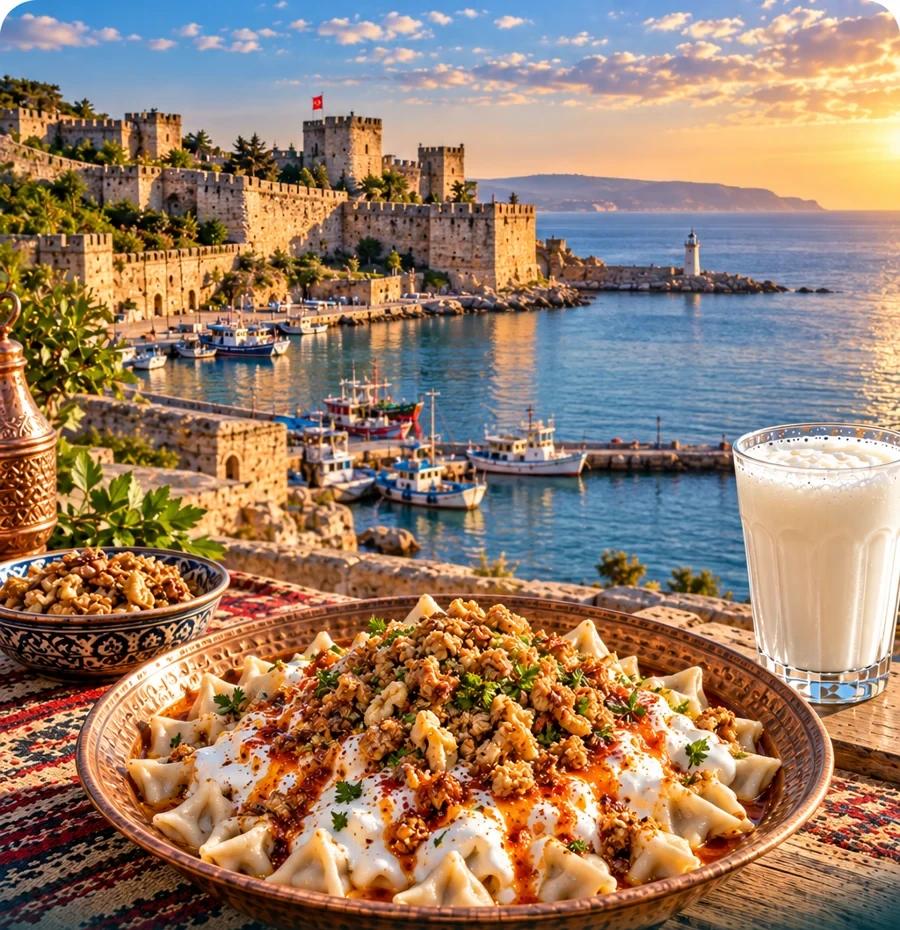
A harbour on the Black Sea, anchovies and mantı with walnuts.
Follow filled dough and maritime food traditions, while keeping district specialties in view.
Dumplings with walnuts and yogurt
Ear-shaped dumplings of thin dough filled with minced beef, served half with walnuts and half with garlic yogurt.
Rolled filled pastry
Yeasted dough rolled thin around a filling of walnuts and raisins or minced meat, rolled up and baked; made for festive tables.
Baked stuffed anchovies
Anchovies laid in a tray with onion, parsley, black raisins and pine nuts and baked.
Lamb roasted on a pole
Whole lamb threaded on a long pole of resin-free wood and turned in front of a pine-wood fire.
Folded pastry
A folded pastry eaten at breakfast with nokul and tea.
Pounded wheat and meat
Wheat cooked at length with meat, made for weddings, Hıdrellez and other community gatherings.
Recipes from this city are coming soon.
Chestnuts grown in Sinop and eaten fresh in season.
Guide not written yetChestnut honey produced in Sinop.
Guide not written yetTomato grown in the Gazidere area of Boyabat.
Guide not written yet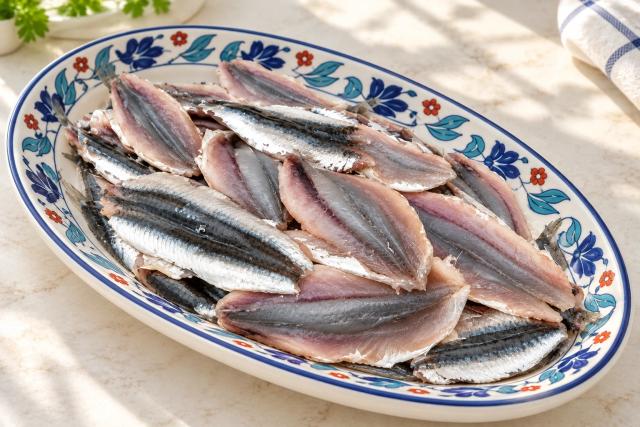
Raw anchovies, cleaned and butterflied, for frying or arranging around rice.
Fish cured in salt and served as a meze.
Guide not written yetModel-boat making, known as kotracılık, connects craft with the city’s maritime identity. The provincial culture directorate traces its local spread through makers and apprentices, including work associated with the former prison. That craft history offers a useful counterpart to the harbour and its food. It also reminds visitors that a city’s culture includes skills and livelihoods, not only monuments and celebrated historical figures.
Sinop mantı is served on one plate, half with walnuts and half with garlic yogurt.
Anchovies go into içli tava, and lakerda keeps an old way of salting fish.
Sinop’s story begins with the city established on the Boztepe promontory in the middle part of the Black Sea Region. Its walls completely encircle the narrowest neck of the peninsula, concentrating the town’s defence on that landward approach. After the Anatolian Seljuks conquered Sinop, an inner castle was built on the order of Sultan İzzeddin Keykavus. It was never only a defensive work: from its construction it also served as a shipyard.
In time, the bastions of the inner castle came to be used as dungeons. The Historical Sinop Prison went on to inspire films, songs and poems, and after it was closed it was converted into a museum. That a shipyard and then a prison occupied the same fortress shows how many different roles the structure took on over the centuries. Inland, in the separate district of Boyabat, Boyabat Castle was built on one of the steep rocky hills of the Gökırmak Valley. Late Roman and Early Byzantine finds exhibited there show that the castle was used from the Late Roman Period through to the Ottoman Period.


