



Slicing evenly
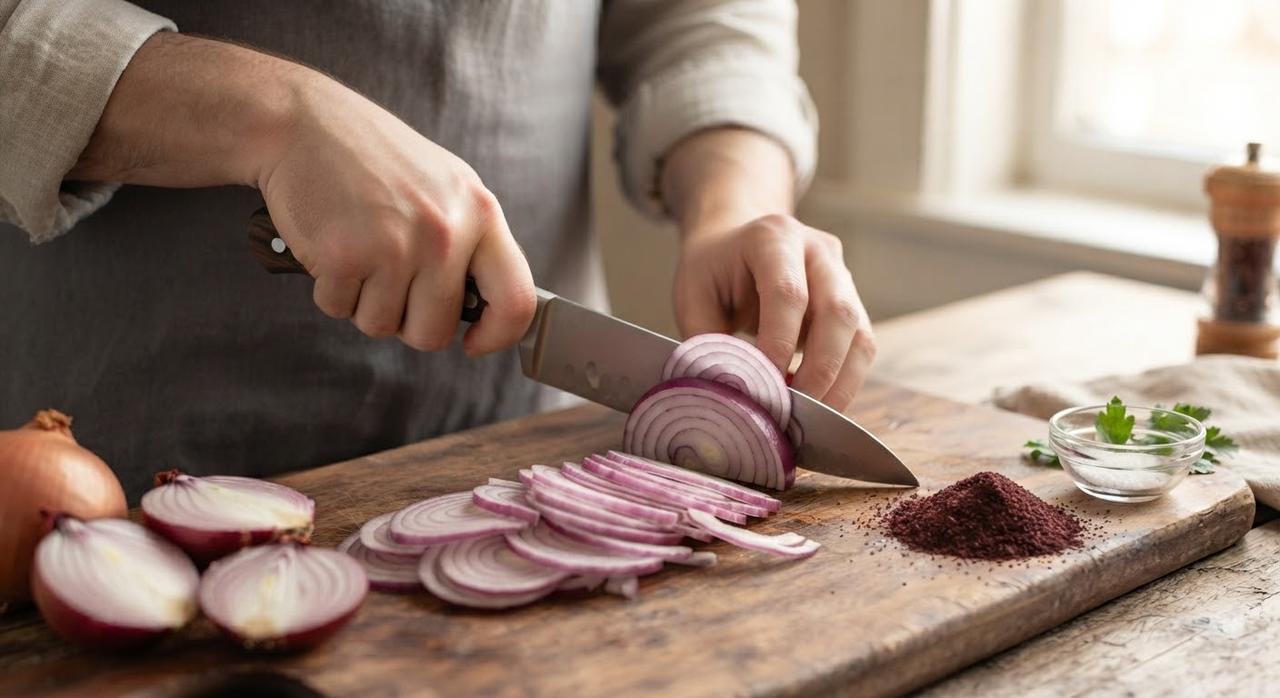
Make slices of a similar thickness with a steady board, a curled guiding hand and a controlled cutting motion.
What this skill is for
Slicing makes flat pieces rather than dice or mince. Use it whenever a recipe asks for slices, rings or half-moons. The ingredient and the recipe decide the thickness; there is no single thinness that suits every dish.
Start with red-onion half-moons, as shown here. The same habit of keeping your cuts evenly spaced helps when slicing cucumber, garlic or other vegetables, although each ingredient needs a stable position of its own. The onion method below is an example, not a requirement to cut every vegetable the same way.
How to do it
- Clear your cutting space. Set a cutting board on a non-slip mat or damp towel so it stays still. Use a sharp knife, and keep its handle and your hands clean and dry. Read the recipe before choosing how thick to slice.
- Hold the knife near the handle–blade junction. Curl the fingertips of your guiding hand inward and tuck your thumb back, keeping them away from the cutting edge. Keep your eyes on the cut and work at a pace you can control.
- For onion half-moons, trim the stem end. Stand the onion on that flat end, hold it by the sides with your fingertips clear of the blade’s downward path, and halve it through the root. Peel it, then set one half flat-side down.
- Hold the onion half with curled fingertips. Slice crosswise from the stem end toward the root with a smooth forward-and-down motion. Keep the spacing between cuts as consistent as you can, moving your guiding hand back after each cut. Follow the thickness your recipe asks for.
- Stop before the root end. If the remaining piece becomes too small to hold securely, put the knife down and reposition it or set it aside. Do not chase a small piece with the blade. Put the knife down before separating the curved slices with your fingers.
- Spread a few slices on the board and compare their thickness. Recut oversized pieces individually if needed. For the next batch, slow down and make smaller, more regular movements of your guiding hand. Salt, sumac and other seasonings belong to the chosen recipe, not to the slicing step.
Recognize success
- Slices are reasonably similar in thickness, with few oversized chunks mixed among thin slivers.
- The onion has distinct curved slices rather than crushed pieces.
- The board and onion stay steady, and you can stop and reset your grip without rushing.
Common mistakes and what to do
- Choosing speed before control: the cut spacing varies and your guiding hand can get too close to the edge. Slow down and reset your grip.
- Cutting an ingredient while it rolls or the board slides: pause and stabilize both before continuing. For the onion half, keep its flat cut side against the board.
- Pressing harder when the knife struggles: stop and check the knife rather than forcing the cut. If tomato skin resists a chef’s knife, use a small serrated knife with a gentle sawing motion.
- Assuming every slice must be paper-thin: follow the recipe. A slice that is too thin cannot be made thicker again; recut only oversized pieces and adjust the next batch.
- Leaving large chunks among fine slices: spread out the pile, identify the oversized pieces and recut them individually instead of chopping the whole pile into smaller pieces.
Last updated:
Practice with a real recipe
Related skills
Preparation & Knife Skills
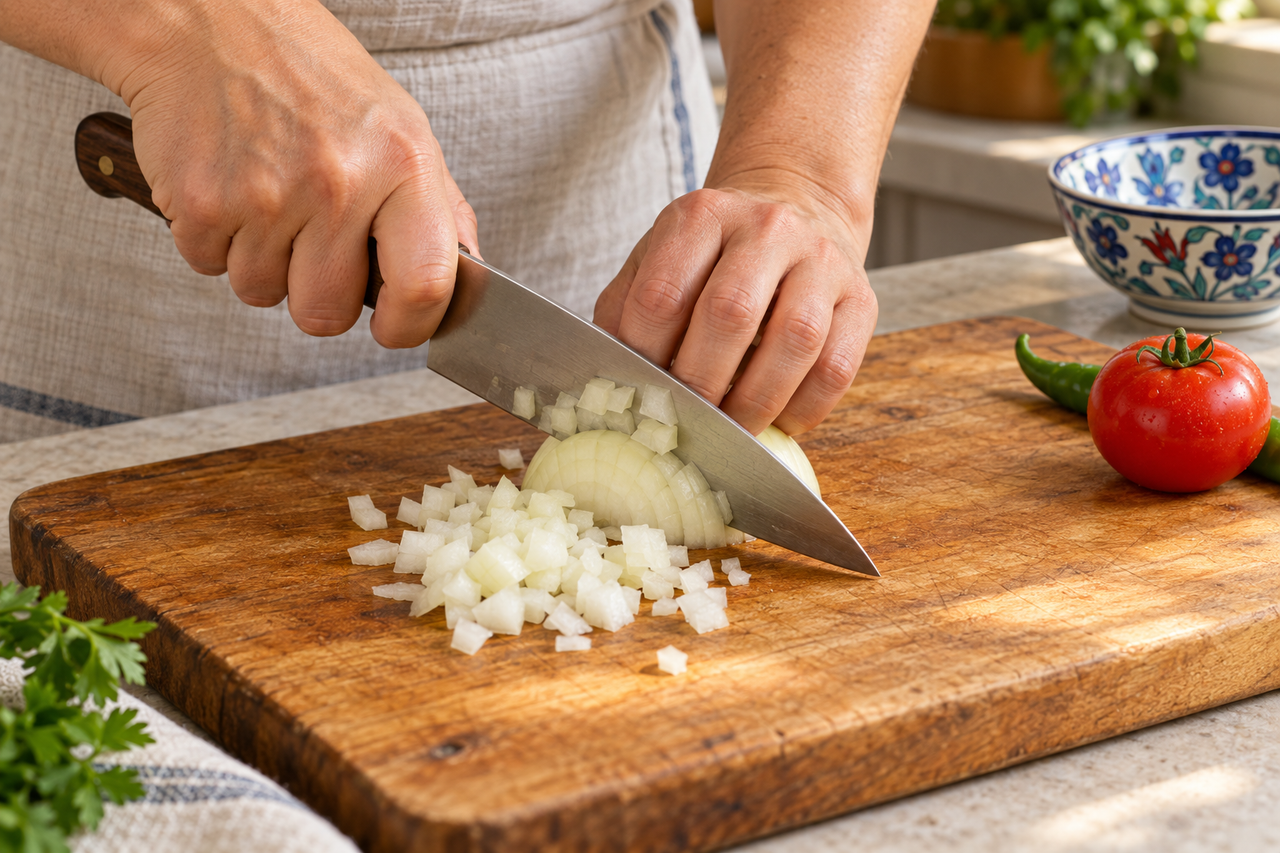
Fine chopping by hand
Keep small vegetable pieces distinct instead of turning them into a watery paste.