


Kaz yemeği
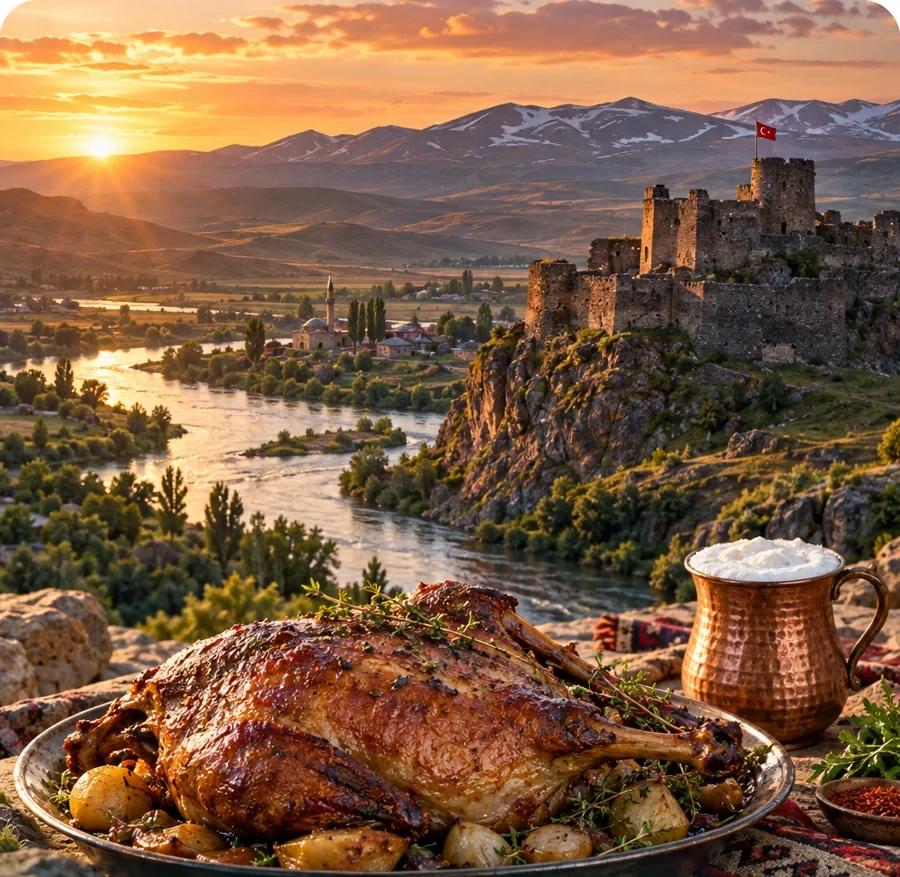
Goose with bulgur pilaf
Salted, air-dried goose cooked and served with bulgur pilaf made in its broth, a winter dish of the region.
Eastern Anatolia
In Ardahan, goose sits at the center of the winter table. Rubbed with rock salt and dried in the cold open air or in a cold room, the goose meat goes into kaz yemeği, a winter dish of the region, where it meets bulgur pilaf cooked in its own broth; the same meat also fills kaz mantısı. Cincar çorbası heads in another direction, bringing dried stinging nettle, sautéed onion and milk together with kavılca bulgur. Kavılca, the wheat behind that bulgur, is a local grain close to einkorn. Among the doughs, two distinct characters stand out: feselli, a yeasted dough coiled into a round and cooked on an iron plate, and kete, a baked pastry that takes walnuts, roasted flour or cheese between its layers. Head towards Posof and the table gains another color: the Posof apple, also called badele, red inside and out. From salted goose to kavılca bulgur and on to the red Posof apple, this route invites you to get to know Ardahan’s cooking through its larder first.
Last updated:
High pastures, lakes and a winter table of goose and bulgur.
Follow the connections between beekeeping, dairy making and layered dough in Türkiye’s northeastern highlands.
Goose with bulgur pilaf
Salted, air-dried goose cooked and served with bulgur pilaf made in its broth, a winter dish of the region.
Goose-filled dumplings
Mantı made with the region’s salted, dried goose meat.
Nettle and bulgur soup
Dried stinging nettle cooked with kavılca bulgur, sautéed onion and milk.
Flour and butter soup
A winter soup made with flour, butter, tomato paste and black pepper.
Coiled griddle pastry
Yeasted dough brushed with fat, rolled up, coiled into a round and cooked on an iron plate.
Filled baked pastry
Rolled dough layered with walnuts, roasted flour or cheese and baked on a greased tray.
Recipes from this city are coming soon.
Goose meat rubbed with rock salt and dried in the cold open air or a cold room.
Guide not written yetFlower honey from the highland meadows, made by Caucasian bees.
Guide not written yetA local wheat close to einkorn, made into kavılca bulgur.
Guide not written yetLarge, white, kidney-shaped beans with thin skins, grown in Posof.
Guide not written yetAn apple red inside and out, grown in Posof and also called badele.
Guide not written yetA cow’s-milk cheese that pulls apart into thin strands, unsalted or lightly salted.
Guide not written yetKaşar cheese made in Göle from the milk of cows grazing on highland pastures.
Guide not written yetDamal’s cloth dolls preserve details of local women’s clothing in miniature. The Ministry’s living-heritage record documents the work of Fidan Atmaca, who learned the clothing craft within her family and taught others. This is a specific maker and district tradition, not a generic souvenir story. Such records help connect cultural heritage with the people who practice and transmit it. In a food guide, they also make room for forms of household knowledge beyond cooking.
Geese raised on the pastures are salted and dried after the first snow, then cooked with bulgur pilaf.
Feselli and kete are rolled, layered or filled, then baked on iron plates or in the oven.
In Ardahan, lakes and hard winters shape the landscape. Lake Çıldır, a tectonic lake, lies in a depression between the Akbaba and Kısır mountains. Because winter here is so challenging, the lake freezes in late November and is covered with thick ice. Akçakale Island on the lake is known as the place where Sultan Alparslan named the castle after adding the region to the Seljuk lands. Lake Aktaş, also tectonic in origin, lies half in Ardahan and half in Georgia.
In the provincial center, the exact construction date of Ardahan Castle is not known; the castle reached the present day after a major restoration in the 16th century ordered by Suleiman the Magnificent. East of the castle, the Mevlit Efendi Mosque was built at the beginning of the 18th century, according to the inscription on its entrance door. The Hamşioğlu Rasim Bey Mansion recalls more recent history: according to an inscription added later, the Ardahan National Council Congresses were held there in January 1919.


