
Skip to content

The Turkish pantry

Sea bass fillets

Fillets provide the edible fish pieces in a soup or a quick cooked dish. Check skin and pin bones, then cut evenly so the pieces finish together.

Last updated:

Raw fillets of European sea bass, Dicentrarchus labrax. Skin-on and skinless fillets remain meaningful preparation choices. This ingredient is separate from the whole fish and from the head-and-frame material used to make stock.
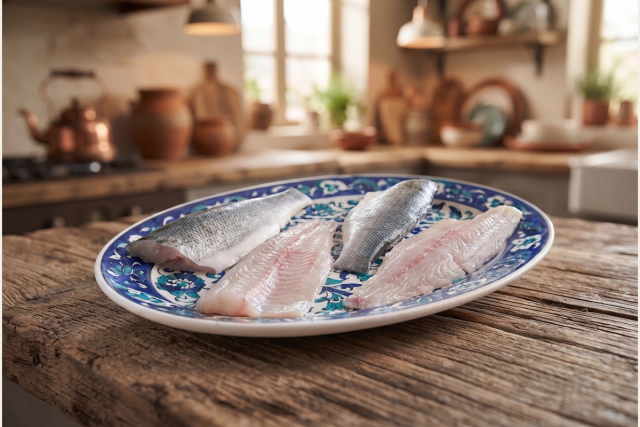
Four raw sea bass fillets, two silver skin-side up and two pale flesh-side up, on a blue and turquoise floral platter on a rustic wooden table in a sunlit kitchen.

Types & forms

Skin-on fillet

The skin remains attached; follow the dish’s instructions for retaining or removing it.

Skinless fillet

Prepared flesh with skin removed; still check for pin bones.

Frozen raw fillet

Choose labeled plain raw fish rather than breaded, smoked or precooked fish.

What to look for when buying

  • Confirm European sea bass and the required skin state. Ask the fishmonger to remove pin bones and check the prepared weight rather than buying by whole-fish weight.
  • Buy cold, firm fillets without dried edges, unusual discoloration or sour smell. Check frozen packs for damage and thawing signs.

Prepare & cook

  • Run clean fingers gently over the flesh to check for remaining pin bones; remove them before cutting. Pat dry and cut to the soup recipe’s size.
  • In our fish soup, the fillet is distinct from the stock-making head and bones. Add the prepared flesh at its stated stage instead of boiling it for the entire stock process.
  • Cook the thickest piece to 145°F. Stir gently once tender so the fish stays in pieces; a flaked appearance alone should not replace the temperature check.

Store it well

  • Keep raw fish in a leakproof container at 40°F or below and use within 1–2 days, or freeze promptly. Follow an earlier use-by date. Thaw in the refrigerator, keeping drips away from other food.
  • For vacuum-packed fish labeled to remain frozen until use, remove it from the vacuum bag before refrigerator thawing. Follow the package instructions; a sealed thawing bag is not a substitute for this step.
  • Divide cooked food into shallow containers and refrigerate within 2 hours, or 1 hour above 90°F. Use refrigerated cooked fish, meat or broth within 3–4 days; reheat leftovers to 165°F. Follow a shorter recipe-specific limit where given.

Substitutions depend on the dish

Another boneless white-fish fillet

Changes species, flavor and firmness. Choose a soup adaptation suited to that fish and match piece thickness.

Whole sea bass or frames

Ask for fillets from the whole fish and measure the resulting flesh. Frames alone do not supply an equivalent serving of fish pieces.

Nutrition

No verified nutrition data is available for this ingredient.

At the Turkish table

Our balık çorbası uses levrek fillet as the fish portion while the head and frame have a separate stock role. Keeping these records distinct helps preserve both the cooking sequence and the ingredient quantities.