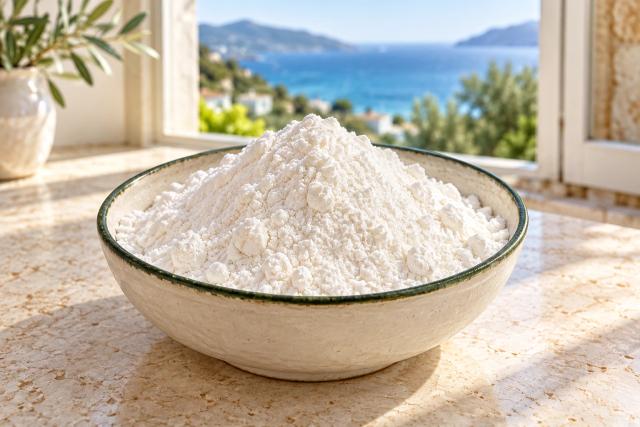
Fine rice flour helps form the tiny meatballs in Yuvalama. Add the measured amount gradually and judge the dough by the recipe’s texture rather than replacing another flour by eye.
Last updated:
Rice milled into flour. The recipe does not specify white or brown rice; ordinary rice flour, brown rice flour and glutinous rice flour are distinct products.
Types & forms
Ordinary rice flour
A finely milled flour for the linked recipe; check the product description and texture.
Brown or glutinous rice flour
These have different composition or binding behavior. Glutinous rice flour means a sticky-rice product, not ordinary rice flour.
What to look for when buying
Choose a clearly labeled plain rice flour rather than a baking blend with added starches or raising agents.
Check the ingredient list and any cross-contact statement if an allergen matters to you; the flour’s name alone does not certify a finished dish.
Prepare & cook
Measure before mixing and break up lumps. Work it into the meatball mixture in the order the recipe gives.
Cook the mixture fully before tasting. Adding extra flour without a texture check can make the tiny meatballs firm or chalky.
Store it well
Keep sealed in a cool, dry cupboard, following the product’s storage instructions and date.
Protect the flour from moisture and pantry pests. Use clean, dry utensils and do not return flour that has touched raw meat to the package.
Substitutions depend on the dish
Wheat flour
Contains different proteins and behaves differently; not a direct replacement for the Yuvalama mixture.
Rice starch
A separated starch rather than whole rice flour; do not swap spoon for spoon without an adapted recipe.
Nutrition
Government reference example: White unenriched rice flour [1]
Per 100 g edible portion
Nutrient
Amount
Energy
366 kcal
Protein
5.95 g
Total fat
1.42 g
Saturated fat
0.39 g
Carbohydrate
80.1 g
Dietary fiber
2.4 g
Total sugars
0.12 g
Sodium
0 mg
Cholesterol
0 mg
Calcium
10 mg
Iron
0.35 mg
Potassium
76 mg
Vitamin D
0 µg
Per 100 g of the stated reference food. The recipe does not specify white or brown rice flour. This example is white unenriched rice flour, not every flour or the cooked meatball mixture. Values are rounded for readability; “not reported” does not mean zero. A “<” value is below the source’s measurement limit.
Nutrition values come from the reference source named above. They are published reference values, not our own measurements. Actual products and cooking methods may change the values.
At the Turkish table
Yuvalama’s small meatballs rely on careful mixing and shaping. Rice flour is one measured part of that mixture, not a reason to label the entire dish gluten-free.
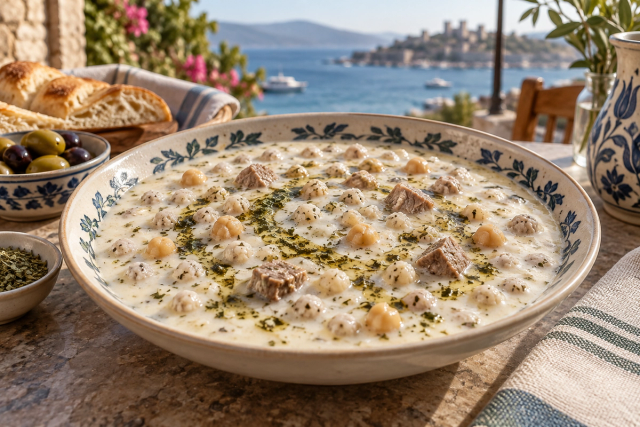
Tiny rice-and-lamb balls, chickpeas and tender lamb in a yogurt broth finished with mint butter. Gaziantep yuvalama is a substantial celebratory dish, often described locally as a meal rather than an everyday soup. This home adaptation uses rice flour for the small balls; traditional preparations may grind soaked rice with meat.