


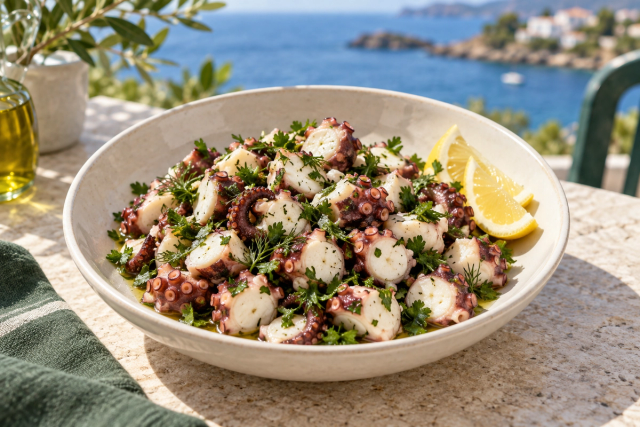
Octopus Salad
Tender octopus pieces tossed with lemon, olive oil, parsley and dill for a bright, chilled seafood salad.
The Turkish pantry
Cleaned raw octopus needs gentle cooking until the thick arm flesh becomes tender before it is cut for salad. Lemon and olive oil dress the cooked pieces; they do not replace cooking.
Last updated:
Raw cleaned octopus, with species unspecified in the ingredient record. Cooked packaged arms and squid are different products and need different handling.

The starting form for the linked salad’s cooking stage; confirm that the beak and internal organs have been removed.
Already tenderized and cooked. Follow its label and an adapted method rather than repeating the full raw cooking time.
Can suit an adapted salad, but their cooked weight and preparation are not the same as raw whole octopus.
Different anatomy and cooking behavior; it is not a direct substitute for octopus in this method.
Government reference example: Raw common octopus (Octopus vulgaris), edible portion [1]
| Nutrient | Amount |
|---|---|
| Energy | 82 kcal |
| Protein | 14.9 g |
| Total fat | 1.04 g |
| Saturated fat | 0.23 g |
| Carbohydrate | 2.2 g |
| Dietary fiber | 0 g |
| Total sugars | 0 g |
| Sodium | 230 mg |
| Cholesterol | 48 mg |
| Calcium | 53 mg |
| Iron | 5.3 mg |
| Potassium | 350 mg |
| Vitamin D | 0 µg |
Per 100 g of the stated reference food. The ingredient does not specify an octopus species. This example is raw common octopus edible flesh, not all octopus species, inedible cleaning waste, cooked meat or dressed salad. Values are rounded for readability; “not reported” does not mean zero. A “<” value is below the source’s measurement limit.
Nutrition values come from the reference source named above. They are published reference values, not our own measurements. Actual products and cooking methods may change the values.
Ahtapot Salatası combines cooked tender octopus with a fresh dressing. Cut size and tenderness matter because the seafood is served in distinct pieces rather than shredded into the dressing.
Tender octopus pieces tossed with lemon, olive oil, parsley and dill for a bright, chilled seafood salad.