


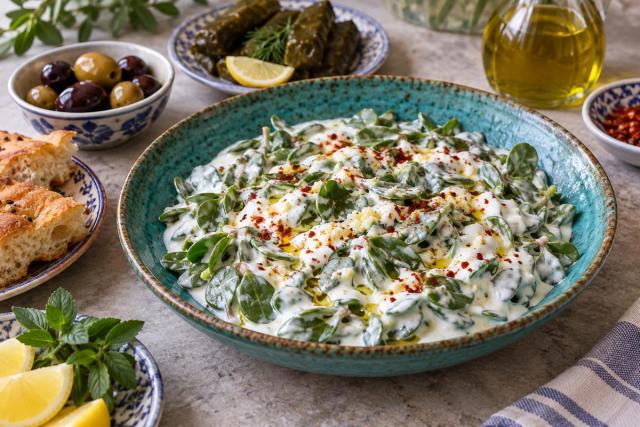
Purslane with Garlic Yogurt
Tender purslane leaves folded into thick garlic yogurt with olive oil and a little red pepper.
The Turkish pantry
A succulent culinary green with tender fleshy leaves and stems.
Last updated:
This guide concerns food-grade culinary purslane, Portulaca oleracea. Its edible tender leaves and stem tips are used in cooking. Ornamental portulaca, unidentified garden weeds, roots and seeds are outside this guide’s ingredient scope; the illustration is not a foraging identification tool.
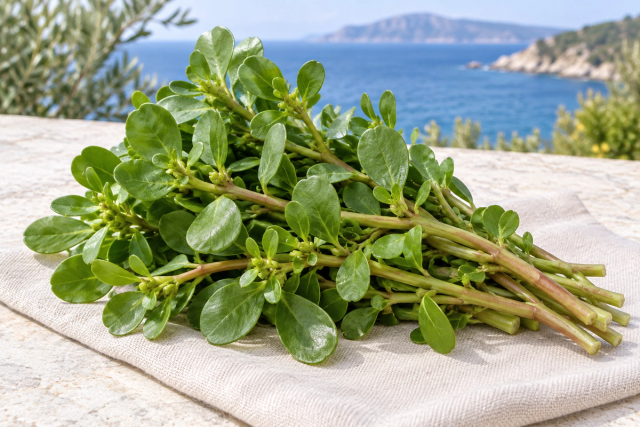
Tender succulent leaves and suitable stem tips.
Cooking softens the green; prolonged cooking can make it slippery.
A similar name or appearance does not establish food suitability.
May work in a recipe that allows it, but lacks the same succulent texture.
Changes both texture and flavor. Treat the result as a variation, not an equivalent purslane dish.
Purslane, raw [1]
| Nutrient | Amount |
|---|---|
| Energy | 20 kcal |
| Protein | 2.03 g |
| Total fat | 0.36 g |
| Saturated fat | Not reported |
| Carbohydrate | 3.39 g |
| Dietary fiber | Not reported |
| Total sugars | Not reported |
| Sodium | 45 mg |
| Cholesterol | 0 mg |
| Calcium | 65 mg |
| Iron | 1.99 mg |
| Potassium | 494 mg |
| Vitamin D | 0 µg |
USDA raw purslane reference per 100 g edible portion. The table does not include dressing, roots or cooked preparation, and it is not a medicinal-use recommendation. Values are rounded for readability; “not reported” does not mean zero. A “<” value is below the source’s measurement limit.
Nutrition values come from the reference source named above. They are published reference values, not our own measurements. Actual products and cooking methods may change the values.
The connected purslane recipe demonstrates how this collection uses semizotu. Any yogurt, oil or seasoning in that dish remains separate from the plain raw-green nutrition reference.
Tender purslane leaves folded into thick garlic yogurt with olive oil and a little red pepper.