


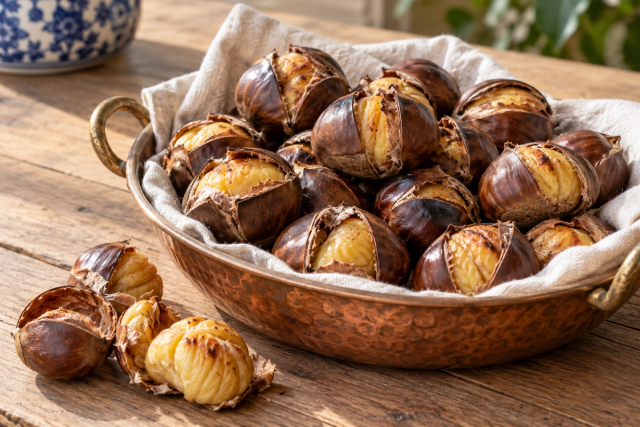
Roasted Chestnuts
Chestnuts scored, soaked and oven-roasted until tender, then rested under a cloth for easier peeling—a home version of a familiar Istanbul winter snack.
The Turkish pantry
Fresh edible chestnuts in their smooth brown shells, prepared by peeling or cooking as a recipe directs.
Last updated:
Edible chestnuts have a brown outer shell, a thin inner skin and a pale starchy kernel. They are used roasted, boiled or in dishes that call for peeled chestnuts. This guide covers the fresh whole nut.
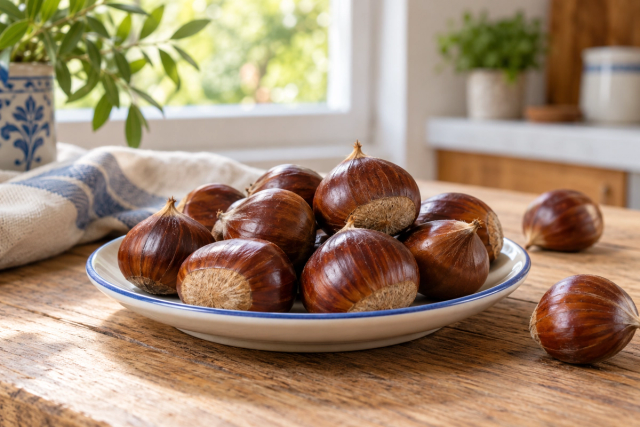
The outer shell and inner skin still cover the kernel; preparation must account for both.
Ready-peeled cooked packs are a different prepared form. They do not need the shell preparation of a fresh chestnut.
Can suit fillings or other dishes that request cooked kernels. Match the prepared form and amount rather than the shell-on weight.
Walnuts and hazelnuts have different texture and composition and do not directly replace chestnuts in a roasted-chestnut dish.
No universal table is provided here; shell-on purchase weight and cooked edible weight are different bases.
Roasted chestnuts are a familiar winter street snack in Istanbul and elsewhere in Türkiye.
Chestnuts scored, soaked and oven-roasted until tender, then rested under a cloth for easier peeling—a home version of a familiar Istanbul winter snack.