Boneless striploin can be sliced very thinly for the beef layer in home-style döner. Keep the meat cold while slicing and cook the assembled dish according to its own method.
Last updated:
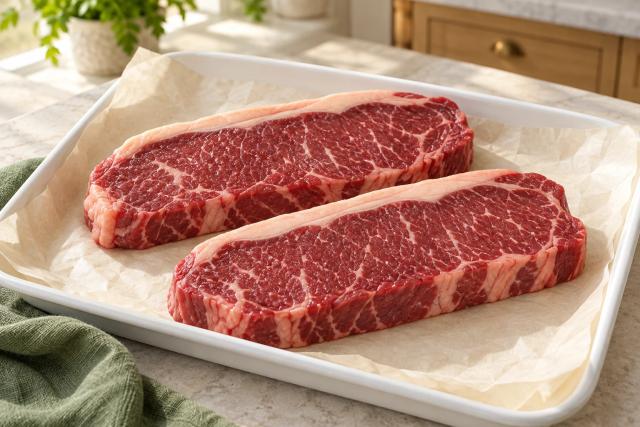
Raw boneless beef striploin, called kontrfile in Turkish and also sold as New York strip. British sirloin commonly refers to this cut; American top sirloin is a different cut.
Types & forms
Boneless striploin piece
A larger piece that can be chilled and sliced thinly across the grain for the linked recipe.
Strip steaks
Individual steaks from the same area; thickness and trimming vary, so prepare them to the recipe’s required shape.
What to look for when buying
Ask for boneless striploin or kontrfile, and clarify local butcher terminology rather than relying on the word sirloin alone.
Choose plain chilled meat. Ask the butcher for very thin slices if cutting them safely at home is difficult.
Prepare & cook
Keep the meat cold and use a sharp knife to make the thin slices required by the recipe. Trim only as directed; do not confuse the slices with the separate ground beef layer.
Follow the complete döner recipe. Because it also contains ground beef, check the assembled meat reaches at least 160°F; the lower whole-steak minimum is not the rule for this mixed preparation.
Store it well
Keep raw meat in a leak-proof container at 40°F or below, separate from ready-to-eat food. Use whole cuts within 3–5 days; use cubed stew meat within 1–2 days, or freeze. Follow an earlier package date.
Thaw in the refrigerator. Refrigerate cooked meat within 2 hours, or 1 hour above 90°F; use refrigerated leftovers within 3–4 days and reheat to 165°F.
Substitutions depend on the dish
American top sirloin
A different cut with different texture and trimming; do not treat the name as an exact striploin match.
Ground beef
The linked döner uses it separately. It cannot replace the sliced meat without changing the preparation.
USDA reference per 100 g of edible raw boneless top loin (striploin), lip-on, lean and fat, trimmed to 1/8-inch outer fat, all grades. Not American top sirloin. Different trimming and finished döner have different composition. Values are rounded for readability; “not reported” does not mean zero. A “<” value is below the source’s measurement limit.
Nutrition values come from the reference source named above. They are published reference values, not our own measurements. Actual products and cooking methods may change the values.
At the Turkish table
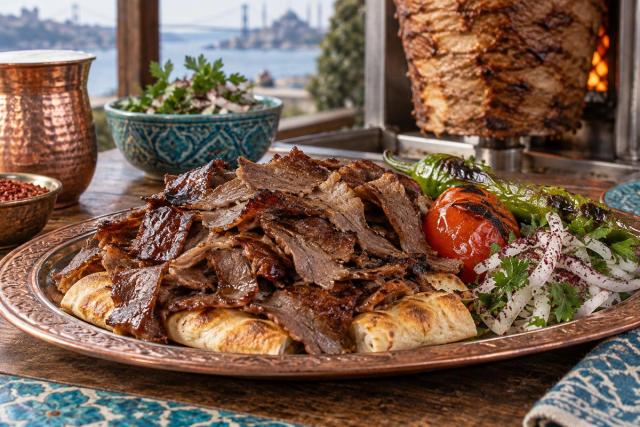
Our home-style Döner Kebab combines very thin beef slices with a separate ground-beef preparation. This guide explains the sliced cut; it does not turn the method into a commercial rotisserie process.
Thin layers of seasoned beef and mince, chilled into a roll, sliced and quickly browned in a skillet. This is a skillet adaptation of layered döner. A restaurant spit uses a different cooking process. Slice only when the roll is firm but safely cuttable; never force a knife through a solid frozen block.